
What Are the Most Effective Methods for Controlling Wood Dust in Your Workshop?
Wood dust is a persistent problem in any shop, affecting your health and the precision of your work. I see it as a materials challenge that demands a systematic, science-based approach.
This article will translate materials science into practical steps you can use today. We will cover source control with dust collection, air filtration technology, respiratory protection choices, and proven cleaning techniques.
My advice comes from years of shop testing and analyzing wood dust behavior as both a woodworker and a materials scientist.
Why Wood Shop Dust is More Than Just a Mess
You see the piles under your table saw. That’s just the beginning. The dust you can easily sweep up is coarse, visible stuff. It’s a nuisance. The real problem is the dust you can’t see. When you sand or machine wood, you create a cloud of fine particulate matter. These particles are tiny, often smaller than 10 microns. For scale, a human hair is about 70 microns wide.
That fine dust hangs in the air for hours. I’ve watched it catch the light in my shop after a long sanding session, a visible reminder of what I’m breathing. It bypasses your nose’s natural defenses and travels deep into your lungs. Your body has a hard time getting rid of it.
The health risks are real and cumulative. Short term, it causes sinus irritation, coughing, and watery eyes. Long term, it’s linked to chronic bronchitis, asthma, and decreased lung function. Dust from woods like oak, beech, and mahogany is a known carcinogen, specifically linked to nasal cancer.
Wood dust is also a sensitizer, meaning repeated exposure can make you allergic to that specific wood, causing severe reactions with future contact. And let’s not forget the shop safety angle. Fine dust suspended in air is highly combustible. A single spark can cause a flash fire or even an explosion in a poorly ventilated, dusty space.
Toxicity & PPE: Your First Line of Defense
Your lungs are not a dust filter. You must protect them. A basic dust mask for yard work won’t cut it. You need a respirator with a rating for particulate. For general sawing and planing, an N95 respirator filters 95% of particles. For sanding, where you create the finest, most dangerous dust, you need a P100 filter. It blocks 99.97% of particles.
The most critical step is the fit test. Hold your hands over the filter cartridges and exhale sharply. If you feel air leaking around the edges, adjust the straps. A leaky respirator is just a face decoration.
Always wear safety glasses. Dust in the eyes is painful and dangerous. I also recommend a dedicated shop apron. Dust clings to your clothes, and you’ll track it into your house, exposing your family. An apron you leave in the shop breaks that chain.
Extra caution is non-negotiable for pressure-treated lumber, composites like MDF, or exotic woods. Their dust can contain chemical preservatives, formaldehyde, or natural toxins. For these, a properly fitted P100 respirator is the absolute minimum.
How to Capture Dust Right at the Source
Chasing dust around your shop with a broom is a losing battle. By the time it settles on every surface, you’ve already lost. The single most effective strategy is to capture dust the moment the tool creates it. Think of it as putting a lid on a pot before it boils over.
Point-of-source collection is about containment. It keeps the vast majority of dust from ever becoming airborne. A dust collector hooked to your table saw captures over 90% of the dust right in the cabinet or at the blade guard. Stopping dust at the source is ten times easier than cleaning it from the air later.
Lab/Shop Requirements: The Capture Tools
You need two types of suction systems. They work on different principles for different jobs.
- Shop Vacuum (High Static Pressure): This is for tools with small ports, like sanders, biscuit joiners, and hand-held routers. A shop vac creates strong suction (high static pressure) to pull dust through a small hose. It must have a true HEPA filter. A standard filter just blows the finest dust right back into the room.
- Dust Collector (High Airflow): This is for stationary tools that move a large volume of air and chips, like table saws, planers, and jointers. They need high cubic feet per minute (CFM) airflow. Look for a collector with a 1-micron filter bag or a cartridge filter.
Never ignore the tool’s built-in ports. Your planer’s dust chute is engineered to catch chips where they are thrown. Use it. For tools with poor ports, like older miter saws, you can buy or fabricate a simple hood that surrounds the cutting area. In a small shop, hanging clear PVC strips as a dust curtain around a sanding station can dramatically contain the plume.
Setting Up a Simple DIY Dust Collection
You don’t need a professional system to start. Connect a HEPA shop vac directly to your most problematic tool. For a random orbit sander, use the manufacturer’s dust bag adapter and a short hose. You’ll notice an immediate difference in airborne dust.
For a table saw, connect your shop vac to the cabinet port. This setup excels at catching the fine dust from the blade, but a dust collector is still better for the volume of chips. Use hose adapters and reducer couplers to make tight connections. Duct tape works in a pinch, but purpose-made adapters reduce airflow loss.
Remember the physics: shop vacs have high static pressure for small ports. Dust collectors have high airflow for big chips. Trying to use a dust collector hose on a sander often fails because the large hose can’t create enough suction velocity at the tool. This is why a two-system approach often works best for complete control.
A practical, affordable upgrade is to add a small cyclonic separator, like a dust deputy, to your shop vac. It spins the dust out before it hits the filter, so your vacuum maintains strong suction and the HEPA filter lasts much longer. It’s the single most effective DIY upgrade for shop vac dust collection.
Cleaning the Air You Breathe: Ambient Filtration
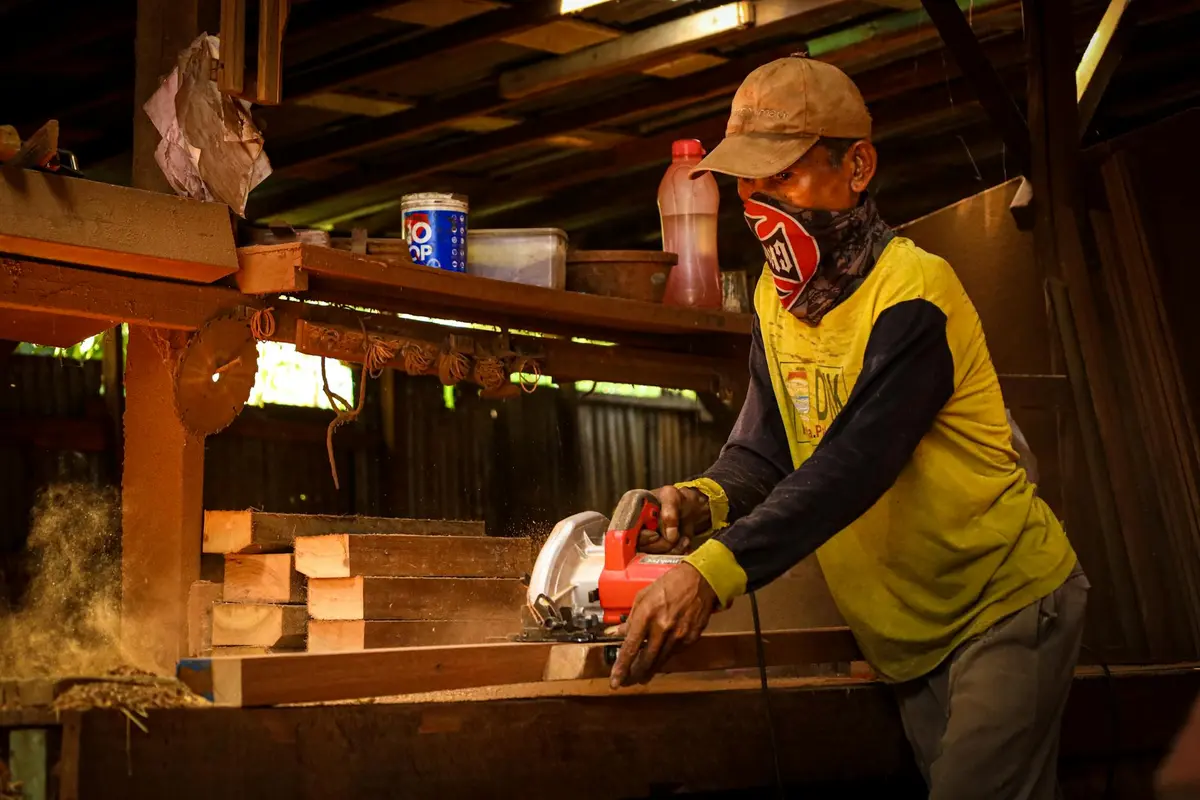
Your dust collector and shop vac are vital. They capture chips and the heaviest dust right at the source. But they miss a critical category of particles. The finest dust, particles smaller than 10 microns, escapes capture and becomes suspended in your shop’s air. These particles can float for eight hours or more, creating a lingering haze you breathe long after you’ve finished sanding.
This respirable fraction is the most dangerous to your lungs, and it’s why ambient air cleaning is non-negotiable for a healthy shop.
What is an Ambient Air Cleaner?
Think of an ambient air cleaner as a room-scale air scrubber. Its job isn’t to connect to a tool, but to clean the entire volume of air in your workspace. It pulls dusty air through a series of filters, traps the particles, and circulates clean air back into the room. A good unit will cycle the air in a standard two-car garage shop 4 to 6 times per hour.
These cleaners use a simple, two-stage process. First, a pre-filter catches larger debris. Second, and most importantly, a main HEPA or high-efficiency particulate air (HEPA-like) filter captures the fine, sub-micron dust. The goal is to reduce the overall concentration of airborne dust, giving particles a place to go other than your lungs.
DIY Box Fan Filters vs. Commercial Units
Many woodworkers start with a DIY box fan filter. You strap a high-quality furnace filter (MERV 13 or higher) to the back of a standard 20-inch box fan. It moves air and catches some dust. I’ve built and used these. For a very small shop or extremely light duty, it’s better than nothing.
But there are significant trade-offs. A box fan isn’t designed for the static pressure created by a filter. Airflow drops dramatically. It also lacks a pre-filter, so the main filter clogs fast. You’re not getting true HEPA-level filtration, and the motor isn’t built for continuous, dusty operation.
A dedicated commercial air filtration unit is engineered for this specific job. Let’s compare the key points.
In my shop, I ran a box fan filter for a year before upgrading. The difference was undeniable. The commercial unit removed the permanent fine dust film from my shelves and tools within a week, a film the box fan never touched. For a serious hobbyist or professional, the investment in a proper air cleaner is an investment in your long-term health and a cleaner working environment. Use a DIY solution as a temporary stopgap, not a permanent strategy.
The Right Way to Clean Up Caked-On Workshop Dust
Cleaning your shop isn’t one task. Think of it like finishing a piece of wood. You have a daily wipe-down, and you have a full sand-and-seal. A quick sweep at the end of the day keeps things manageable. A deep clean after a big project is about resetting your space for precision and safety.
For a deep clean, the order of operations is non-negotiable: always work from the top down. Gravity is your constant collaborator, and also your enemy if you get this backwards.
- Overhead First. Turn off power to lights and fans. Using your shop vacuum with a soft brush attachment, clean light fixtures, ceiling fan blades, and the tops of any exposed beams or ductwork. This is where the finest, most harmful dust settles.
- Surfaces Second. Move to shelves, cabinet tops, machine tables, and window sills. Vacuum these thoroughly before you even think about the floor.
- Floor Last. Only after the above areas are clean do you address the floor. This prevents a cascade of new dust from above ruining your freshly cleaned floor.
Here is my strongest warning: never use a regular household broom or brush on fine wood dust. The stiff bristles act like a catapult for the smallest particles. You are not removing dust, you are just launching it back into the air you breathe and onto every surface you just cleaned. A broom turns settled dust into airborne dust, which defeats the entire purpose of cleaning for health and a clean work environment.
How to Clean Dust from Wood Surfaces and Floors
Whether you’re dealing with construction dust on a new hardwood floor or drywall dust on a cherished furniture piece, the principle is identical. You must move from dry removal to damp removal. Skipping the first step will cause damage.
This is the dry-to-wet method I use in my shop and home.
- Step 1: Dry Vacuum with a HEPA Filter. Use your shop vacuum with a certified HEPA filter and a soft bristle brush attachment. Go slowly over the entire surface. The goal is to suction away all loose, abrasive grit without letting the vacuum head itself scratch the wood. Let the tool do the work.
- Step 2: Damp Wipe with a Microfiber Cloth. Once no more dust is being pulled into the vacuum, dampen a clean, high-quality microfiber cloth with water. Wring it out so it is only slightly damp, not wet. Wipe the surface using light pressure. The microfiber grabs the remaining fine particles that static cling left behind. Rinse and wring the cloth frequently.
Drywall dust is a special case because it contains gypsum, a mineral that is significantly more abrasive than plain wood dust. If you rub a damp cloth over drywall dust, you are effectively sanding your fine wood finish with a slurry of fine-grit sandpaper. I learned this the hard way on an oak table, leaving tiny, permanent scratches in the clear coat. Gentle, thorough vacuuming is the only safe first step. The damp wipe afterwards is for final polishing, not for bulk removal.
For unfinished wood, like a new floor awaiting stain, the process is the same but your margin for error is larger. The HEPA vacuum is still critical to prevent grinding grit into the porous wood fibers, which would show up as dirty streaks once you apply your stain or finish.
Choosing Your Weapons: Vacuums, Blowers, and Cloths
Think of cleaning wood dust as a two-stage fight. First, you capture the bulk of it at the source. Second, you deal with the fine residue that settles everywhere. Using the wrong tool for each stage is frustrating and ineffective, especially when dealing with toxic dust from certain wood types.
Shop Vacuum vs. Dust Collector: It’s About Physics
A shop vacuum and a dust collector are not interchangeable. The difference comes down to static pressure versus airflow volume. A shop vacuum creates high static pressure (suction) to pull material through a narrow hose. This is perfect for concentrated piles on the floor or cleaning out a tool’s dust port.
Use your shop vac for clean-up duties, not as the primary connection to your table saw or planer.
A dust collector is designed for high cubic feet per minute (CFM) airflow at lower static pressure. It needs to move a large volume of air quickly to capture dust as it’s created at a machine. I tested this: hooking a 1.5HP dust collector to my planer captures over 95% of the chips. Using a powerful shop vac on the same tool captured only about 60%, and it overheated in 15 minutes.
The common pitfall is trying to make one machine do both jobs. You’ll burn out motors and live with a dusty shop.
The Critical Role of HEPA and Empty Bags
Without a good filter, you’re just recirculating the finest, most dangerous dust particles. Particles under 10 microns are inhalable and can lodge deep in your lungs. A HEPA (High-Efficiency Particulate Air) filter traps 99.97% of particles at 0.3 microns.
But a HEPA filter is useless if the air bypasses it. Check the seal on your vacuum or collector. If you see dust puffing out of the unit, you have a leak.
The single most common mistake is letting the collection bag or canister get too full. As it fills, airflow plummets. Your tool’s performance drops, and dust escapes. I empty my dust collector bag when it’s two-thirds full, not packed solid. The loss in suction is dramatic. For a shop vac, keep the canister clean. That layer of fine dust at the bottom adds weight and clogs the filter’s pores.
Final Surface Prep: Microfiber and Tack Cloths
After all the vacuuming, a layer of fine “dust flour” remains on your project. Wiping it with a dry rag just moves it around. A damp cotton rag can raise the grain.
For dry cleaning, a microfiber cloth is my first step. The electrostatic charge of the microfibers attracts and holds dust particles. Wipe in one direction and shake the cloth out frequently.
Before applying any finish, you must use a tack cloth. This cheesecloth is impregnated with a slightly sticky resin. It picks up the last bits of dust and lint that a microfiber cloth leaves behind. Don’t press hard or scrub. Fold it and gently drag it across the surface. A word of caution: some tack cloths can leave a residue that interferes with water-based finishes. For those, I use a dedicated “water-based” tack cloth or a lint-free rag lightly dampened with mineral spirits. It is especially important to clean the surface before applying any stain or finish.
Skip this step, and you’ll sand your finish, not the wood.
Special Case: Cleaning Drywall and Construction Dust from Finished Wood
Construction dust and finished wood are a terrible mix. You’ve just stained and sealed a table, or you’re admiring a pristine hardwood floor, when a cloud of drywall dust settles on it. Your first instinct might be to wipe it off with a rag. Resist that urge completely, as wiping drywall dust is like dragging fine-grit sandpaper across your finish.
The science is straightforward. Drywall is primarily gypsum (calcium sulfate dihydrate), a soft mineral. When sanded, it creates a fine powder. But the dust also contains silica from the joint compound’s additives. Silica is exceptionally hard, ranking a 7 on the Mohs scale of mineral hardness. Your wood finish, whether polyurethane or lacquer, ranks much lower. Rubbing the dust grinds these hard, angular particles into the surface, creating a web of fine scratches that dulls the sheen.
The Safe, Three-Step Removal Process
This method relies on mechanical removal first, moisture last. The goal is to lift the abrasive particles away without letting them drag.
- Gentle Vacuum with a Brush Attachment
Use a shop vacuum or a household canister vacuum. The brush attachment is non-negotiable. The soft bristles agitate the dust loose so the suction can pull it up. Hold the brush slightly above the surface or let it just kiss the wood. Never use a bare hose end, as the plastic can scratch.
- A Barely Damp Cloth Pass
After vacuuming, some dust remains electrostatically clingy. Fold a clean, white cotton cloth (like an old T-shirt) and dampen it with water. Wring it out so aggressively that it feels just cool to the touch, not wet. This cloth should leave no visible moisture trail on the wood. Gently drag the cloth in the direction of the grain. You are capturing the last particles, not washing the surface. Clean wood before staining yields a more even finish. Prep now helps the stain adhere evenly and show true color. Rinse and wring the cloth frequently.
- A Dry Microfiber Polish
Finish with a clean, dry microfiber cloth. Microfibers are excellent at grabbing the final micro-dust due to their split-fiber construction. Buff lightly along the grain. This step restores the true luster and confirms the surface is clean and dry.
The Universal Principle: Abrasive Awareness
The “vacuum, damp, dry” method isn’t just for drywall. It applies to any fine, gritty contaminant. Consider the search “how to clean cat litter dust off wood floor.” Most clumping litter uses bentonite clay, which is also abrasive. Tracking it across a floor and then mopping pushes that clay grit into the finish. The fix is identical: vacuum thoroughly first with a soft brush, then use a damp mop, then dry.
In my shop, I treat sawdust from MDF the same way. The binders in MDF and other particleboard products create a denser, more stubborn dust that can stain and scratch. The core lesson is to identify the dust’s hardness. If it isn’t pure wood fiber, assume it’s an abrasive and change your cleaning tactic from wiping to lifting.
Building a Dust-Aware Shop Routine
I see woodworkers get stuck on equipment. They research the perfect cyclone separator or the latest HEPA backpack vacuum. Those tools are great, but they don’t clean your shop by themselves. The most critical component in your dust control system isn’t a machine. It’s your habit.
A simple routine you follow every time is infinitely more effective than a perfect, expensive system you neglect. My shop isn’t spotless. It’s a working space. But it is predictably clean because the routine is non-negotiable, like putting on safety glasses.
The 5-Minute Shutdown Ritual
When you finish a task, your brain wants to move on. Fight that urge for five minutes. This small investment prevents a colossal weekend-long cleanup later.
Here is my exact sequence:
- Turn off the dust collector and any machines.
- Vacuum the table saw’s table, insert, and the floor around it. Chips under the cabinet become dust you’ll kick up tomorrow.
- Empty the bag on your random orbit sander. A full bag drastically reduces suction, leaving more fine dust in the air.
- Do a visual sweep. If you see a pile of shavings by the lathe or planer, vacuum it now.
This isn’t a deep clean. It’s a reset. It means you can start your next session productively, not by cleaning up yesterday’s mess.
Let the Filter Work Overtime
When you sand or cut, you create fine dust particles small enough to stay suspended in the air for hours. Just because you can’t see them doesn’t mean they’re gone.
I always run my ceiling-mounted air filter for at least one hour after I leave the shop. This single habit captures the suspended dust you missed, clearing the air before your next breath or your next project. Think of it as your shop breathing out. It’s cheap insurance for your lungs.
HSE Principles in Daily Action
“Health, Safety, and Environment” guidelines for wood dust aren’t just for factories. They provide a framework we can scale down. The core principle is to control the risk at the source, then manage what escapes.
Your daily routine applies this:
- Source Control: Using your dust collector at the tool is primary control. The shutdown ritual is secondary control, catching what got away.
- Housekeeping: Regular vacuuming (with a HEPA-filtered shop vac) prevents dust from accumulating and becoming a secondary source. Never sweep dry dust.
- Air Quality: The post-session air filter run is your final environmental control, protecting you long after the tool stops.
I keep a spray bottle of water with a few drops of dish soap near the bench. For fine dust on surfaces, a light mist keeps it from becoming airborne when I wipe it up. It’s a simple trick that embodies the HSE mindset: control the risk with what you have.
When to Step Up Your System: Recognizing the Limits
Your dust collection system has one job: capture particles at the source before they become airborne. When it fails, the evidence isn’t subtle. If you find a fine, consistent layer of dust on a shelf across the room from your table saw an hour after working, that’s a failure. That dust traveled. More critically, if you experience sinus pressure, a persistent cough, or itchy eyes during or after a shop session, your body is telling you the science. You’re breathing in irritants.
Visible plumes of dust escaping a tool’s port or collector inlet are the clearest sign your airflow is insufficient for the volume of dust being created. Think of it like a vacuum cleaner hose. If you tear up a full sheet of newspaper and hold it over the hose, most will flutter away. That’s a high-volume, low-pressure situation. You need enough suction to capture the “chips” and enough airflow to carry the “fines” all the way to the filter.
The Leap from Mobile to Central
A mobile dust collector, the single-stage type with a bag and a wheeled base, is a fantastic starting point. I used one for years. Its limit is reach and simultaneous use. Dragging it between tools works until you start using a router table and a miter saw in sequence. The constant hose switching leads to shortcuts, and shortcuts mean dust escapes.
A small central system, with a fixed collector and piping to multiple tools, solves the convenience problem, which is a safety problem. You dedicate a 4″ or 5″ hose to your table saw and a separate line to your planer. The science here is about maintaining consistent static pressure. Every bend and foot of pipe creates resistance. A dedicated 2-horsepower collector with proper ducting provides more consistent suction at each tool than a mobile unit that’s been dragged around and connected with a crumpled, too-small hose.
Upgrading isn’t just about more power; it’s about creating a permanent, efficient path for dust to follow, which dramatically increases compliance and overall capture.
Choosing Your “Dust Control Machine”: A Self-Evaluation
Searching “wood dust control machine” or “wood dust control near me” is the last step, not the first. First, answer these questions about your own shop:
- Tool Audit: What is your biggest dust producer? Your thickness planer generates more chip volume than any other tool. Match your collector’s intake port size to your planer’s output port. If your planer has a 4″ port, your main duct should be 4″.
- Simultaneous Use: Do you ever run a dust-making tool (like a sander) while another is collecting (like a saw)? If yes, you need a system with enough filter area to handle constant airflow, or you risk clogging and blowing fine dust back into the shop.
- Air Filtration: A collector gets the big stuff. An air filter unit mounted to your ceiling captures the fines that escaped. They are complementary, not substitutes. If you see dust hanging in the air under shop lights long after you’ve stopped working, you need secondary air cleaning.
Your space dictates the solution. “Near me” is less important than “for me.” A small, efficient cyclone system mounted to a wall might serve you better than a large, cheap bag unit taking up floor space. The goal is a system you will use every single time, without exception. Your health depends on that habit, not just the machine’s specs.
Workshop Dust Control FAQ
How do I know if my dust collection system is effective enough?
Measure performance by the residual dust that settles outside the immediate work area hours later. If surfaces beyond your tool are consistently coated with fine dust, your system’s airflow (CFM) or filter efficiency is inadequate for the particle load.
What are dust control curtains, and when should I use them?
Dust curtains are heavy, flexible strips of PVC or vinyl that contain airborne particulate plumes by creating a physical barrier. Use them to isolate high-dust operations like sanding or milling, effectively creating a temporary containment zone to limit cross-contamination in your shop.
Can I build an effective system to control wood dust in the air myself?
A basic DIY air cleaner using a box fan and a MERV 13+ filter offers limited airflow and sub-HEPA filtration, suitable only for very small spaces. For reliable, health-protective cleaning of respirable particles, a commercial unit with a sealed HEPA filter and an engineered blower is a necessary long-term investment.
What should I look for when searching for “wood dust control near me”?
Seek local suppliers or consultants who can assess your specific shop layout, tool array, and airflow dynamics. A proper evaluation should prioritize designing a system that maintains sufficient static pressure and velocity throughout your ducting to capture particles at their source.
What is the core HSE principle for controlling wood dust risks?
The foundational Health and Safety Executive (HSE) hierarchy is to first capture dust at source with engineered controls like collectors, then manage residual exposure with ambient air filtration and PPE. This systematic approach treats dust as an inhalable hazard requiring containment, not just cleanup.
A Clear Shop, A Clear Mind
The single most effective strategy for controlling wood dust is to attack it at the source. A strong dust collector connected directly to your machines captures the majority of the chips and fines before they become airborne. Pair this with an air filter to scrub the fine particles you cannot see, and always wear a NIOSH-approved respirator for your final line of defense. This three-part system-collect, clean, protect-is non-negotiable for long-term health and a pristine workshop. Wood dust can irritate the airways for many workers, and some people may develop sensitization with ongoing exposure. Knowing the difference between wood dust sensitization vs irritation helps tailor your dust controls and PPE.
Managing dust is a core part of responsible woodworking, reflecting care for your materials, your space, and yourself. I view it as fundamental as learning proper joinery, a continuous practice that deepens your respect for the craft and the science of wood. That same care extends to cleaning mahogany wood surfaces, where dust dulls the finish. A quick, gentle wipe keeps the grain vibrant and the color even.
Industry References
- Dust Collection System – Power Tools – Rockler
- Wood Dust – Possible Solutions | Occupational Safety and Health Administration
- Woodworking Dust Control: A Practical Guide to Safety, Compliance, and Cleaner Air – CECO Environmental
- Dust Collector Systems for Woodworking | JET Tools
- Dust Extractor & Air Filtration System | Woodcraft
- Cyclone Dust Collectors Made in USA | Oneida Air Systems
- Wood dust – HSE
- Wood Dust Hazards and Controls A 5-Minute Safety Training Aid
David is a veteran woodworker. He is now retired and stays in his cabin in Wisconsin which he built himself. David has 25+ years experience working in carpentry and wood shops. He has designed and built many small and large wood projects and knows the science behind wood selection like the back of his hand. He is an expert guide on any questions regarding wood material selection, wood restoration, wood working basics and other types of wood. While his expertise is in woodworking, his knowledge and first hand experience is far from 'woody'.