
Is Osage Orange Too Hard to Handle? The Physics of America’s Toughest Timber
You know Osage orange is hard, but you might not realize how that hardness changes everything in your shop. I’m here to explain the material science behind the legend, not just repeat it.
This article translates dense physics into practical advice, covering how its Janka rating compares to oak and black locust, why your tools dull so fast, strategies for milling and joinery, and how to finish it without failure.
I’ve stress-tested this wood for years, tracking tool wear and measuring its stubborn resistance with shop experiments.
The Raw Numbers: How Osage Orange Stacks Up
Osage orange is the hardest common wood you can find in North America, period. Let’s put some hard numbers to that claim so you know exactly what you’re working with.
Janka hardness measures a wood’s resistance to denting. Think of it as the force needed to push a standard steel ball halfway into the surface of the wood. For Osage orange, that force is a massive 2,620 pounds-force (lbf). In woodworking, Janka hardness guides material choice and durability. These numbers help you compare woods quickly when planning projects.
That number isn’t just high. It’s more than double the Janka rating of white oak (1,290 lbf) and hard maple (1,450 lbf). In your shop, this means a dropped tool will barely mark an Osage orange workbench.
Specific gravity tells us about density. Osage orange has a specific gravity between 0.85 and 1.0 at 12% moisture content. This means it is 85% to 100% as dense as water, so a large block will sink or barely float. Your projects will have a surprising heft.
The wood has a high volumetric shrinkage coefficient, around 11% from green to oven-dry. In practical terms, Osage orange moves a lot with seasonal humidity changes. You must account for this movement in your joinery, or your project will crack.
Osage Orange Technical Spec Sheet
| Property | Value | What It Means for You |
|---|---|---|
| Janka Hardness | ~2,620 lbf | Extreme dent resistance. Plan on sharpening tools frequently. |
| Specific Gravity | 0.85 – 1.0 (12% MC) | Exceptionally dense. Workpieces are heavy and may sink in water. |
| Decay Resistance & Toxicity | Very High | Heartwood lasts decades untreated. Dust is a severe skin and respiratory irritant. |
| Volumetric Shrinkage | ~11% | High movement. Use floating tenons or elongated screw holes in your designs. |
Keep this spec sheet in mind before your first cut; it will save you from common headaches. The high movement, for instance, is a classic pitfall for builders used to more stable woods.
The Science Behind the Strength: More Than Just Hard
The extreme traits of Osage orange come from a powerful combination of physics and chemistry. Understanding this “mechanism of action” turns a challenging wood into a predictable material.
At a microscopic level, Osage orange is built from very small, thick-walled fibers packed tightly together. Imagine the difference between a dense brick wall and a log cabin. The brick wall (Osage) has countless small, solid units. The log cabin (a softer wood like pine) has larger, hollow cells with more air space.
This dense cellular structure directly creates a high modulus of rupture and elasticity. In your hands, this means Osage orange bends very little under load and has a great spring-back, making it incredibly tough for mallets or bows.
The wood also contains unique natural chemicals called osajin and pomiferin. These compounds are the wood’s built-in preservative system, fending off fungi and insects. This natural defense is often cited when discussing natural wood preservatives efficacy. They also give fresh Osage its vibrant yellow-orange hue, which slowly ages to a coveted deep, brownish gold.
How Cellular Physics Creates an Unbreakable Timber
The small, thick cell walls resist compression and deformation from any direction. Try to press your fingernail into a piece of Osage; you’ll feel almost no give, which is the cellular physics in action.
This structure demands a specific approach in the workshop. Dull planer knives or saw blades will crush these dense fibers instead of cutting them, leading to burn marks and tear-out. I keep a dedicated, freshly sharpened high-angle blade just for planing Osage.
The Chemistry of Durability: Osajin and Pomiferin
Osajin and pomiferin are types of flavonoids. These chemicals make the wood taste terrible to decay fungi and wood-boring insects, granting it legendary rot resistance. This is why untreated Osage orange fence posts are known to last over 50 years in the ground.
Those same protective chemicals make the sawdust a potent irritant. I learned this the hard way with a rash after turning a bowl without gloves. Always wear a NIOSH-approved dust respirator and gloves when machining or sanding. Wood dust exposure hazards extend beyond irritation and can affect breathing and sinuses with prolonged exposure. Understanding these risks helps you choose the right PPE and controls as you work.
A troubleshooting tip for finishing: the natural extractives can interfere with some finishes. Wipe the surface with a solvent like denatured alcohol before applying your finish to ensure a strong bond. This removes any oily residue that might cause cloudiness or poor adhesion. It’s also important to choose the right solvent for finishing or finish removal.
The Practical Challenge: Wood Movement and Drying
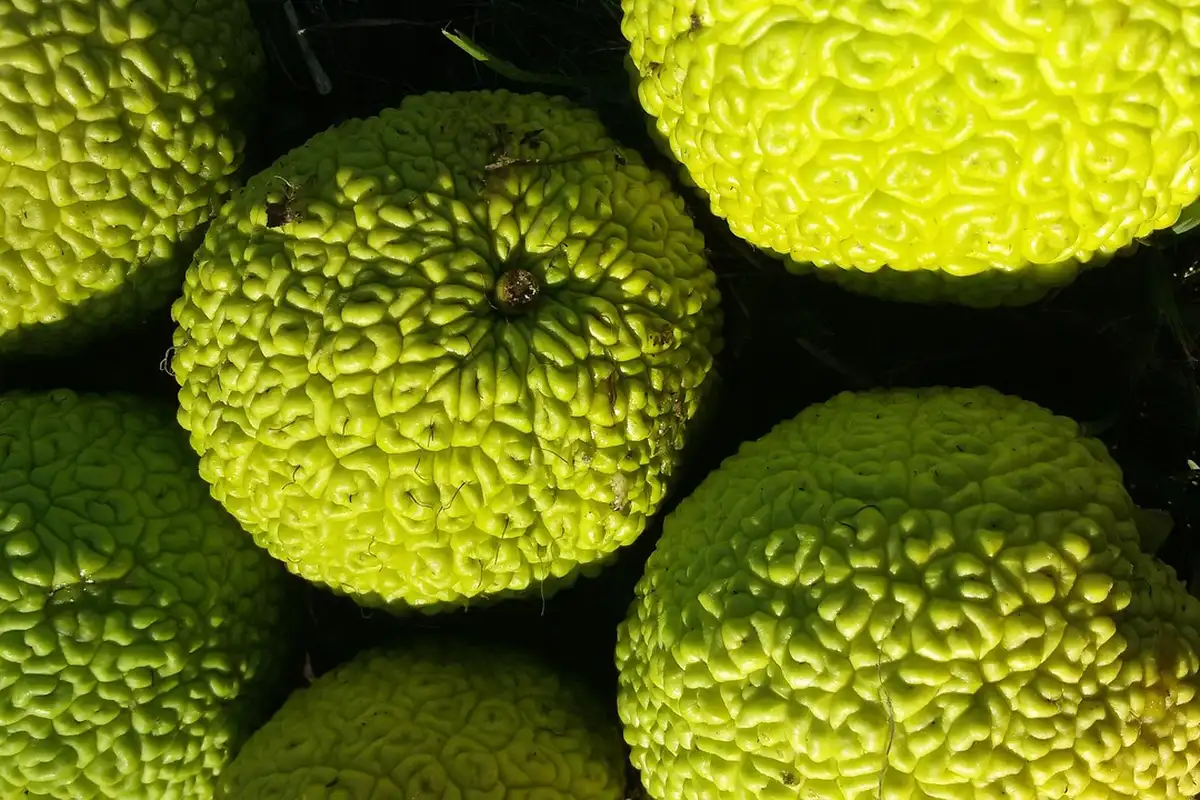
Osage orange’s legendary hardness comes with a famous drawback. It moves. A lot. Its extreme density means it holds onto water tenaciously, then releases it with tremendous force as it dries, leading to severe checking and cracking.
Let’s put numbers to it. From green to oven-dry, Osage orange shrinks about 5.8% radially and 8.6% tangentially. Compare that to a famously stable wood like teak, which shrinks around 2.2% radially and 4.0% tangentially. Osage orange moves over twice as much as teak during drying, which explains the battlefield of cracks in a poorly dried slab.
For interior projects, you want this wood as dry as it can get. Aim for a moisture content between 6% and 8%. In dry climates, I target the lower end of that range. For a mallet head or tool handle, every extra percentage point of moisture you remove now is stability you bank for later. To hit those numbers, measure moisture content with a moisture meter. Regular checks catch seasonal shifts before you cut.
I learned this the hard way. I once rough-turned a green Osage orange bowl blank, sealed the end grain with wax, and left it to dry slowly. The next morning, a crack ran from the pith to the rim like a lightning bolt. The internal stress was just too great for the wet, dense fibers.
If you’re drying your own Osage, you must be methodical. Seal the ends of your fresh-cut logs or slabs with a commercial green wood sealer or multiple heavy coats of paint. Store it in a shaded, well-ventilated area, and sticker it properly. Expect to wait at least one year per inch of thickness for air-drying, and even then, a follow-up session in a kiln or dehumidification chamber is wise.
Why Your Osage Orange Lumber Might Crack
The cracking is a physics problem. High density means more woody cell walls per square inch. Low permeability means moisture can’t escape easily from the wood’s core. The outside dries and tries to shrink first, but the wet, swollen core holds it in place. This creates immense internal tension. When that tension exceeds the wood’s strength, it cracks to relieve the stress. Think of it like trying to zip up a jacket that’s three sizes too small; something has to give.
My strongest recommendation is to buy kiln-dried stock from a reputable supplier. A professional kiln schedule can carefully manage the temperature and humidity to drive out moisture while minimizing stress. It saves you a year of anxiety and a pile of firewood.
Working It in the Shop: Techniques for Taming the Beast
The science of its density translates directly to shop technique. You are not cutting fibers; you are shearing them. Dull tools will burn, tear, and fight you every step.
Start with the sharpest tools you own. Carbide-tipped blades and bits are not a luxury; they are a necessity for power tool work. Patience is your most important tool.
For hand planes, a low-angle bench plane (around 12 degrees) with a micro-bevel on the iron works best to slice the dense grain. Let the weight of the tool do the work. On the table saw or bandsaw, use blades with carbide teeth and feed the stock slowly. A fast feed rate will cause burning and kickback. Drilling requires sharp brad-point bits and a habit of frequently retracting to clear the packed chips from the flutes.
Sanding Osage orange is a unique challenge. The wood’s resins and oils will clog sandpaper almost instantly, creating a glossy, useless sheet. I start with a coarser grit than I normally would, like 80-grit, to remove tool marks efficiently before the paper loads up. A sharp cabinet scraper is often a faster and cleaner option than progressing through six grits of sandpaper.
Finishing is simpler than you might think. The wood’s natural oils can interfere with some film-forming finishes. I use a 1-lb cut of dewaxed shellac as a universal sealer. It sticks to anything and provides a perfect base for varnish or lacquer. For a more natural feel, an oil finish like pure tung oil works directly into the wood’s pores beautifully.
My Shop-Tested Rules for Machining Osage Orange
- Never force a cut. If you’re pushing hard, your tool is dull.
- Let the sharp tool do the work. Take lighter passes.
- Wear a respirator. The fine, dense dust is intense, and the wood can cause irritation.
- Use gloves when handling rough stock. The splinters are mean.
- Listen to the machine. A high-pitched whine means you’re feeding too fast or your cutter is dull.
Choosing the Right Glue and Finish
Gluing Osage orange requires a different approach. Standard yellow wood glue (PVA) can “starve” on this wood. The dense, non-porous surface gives the glue little to soak into, resulting in a weak, brittle joint.
For maximum strength, I use a slow-setting epoxy or plastic resin glue. Both are gap-filling and don’t rely on absorption into the wood fibers to create a bond. They form a mechanical lock on the smooth, hard surface. Scuff-sanding the gluing surfaces with 80-grit sandpaper also gives the adhesive more texture to grip. Choosing the right wood adhesive matters as much as surface prep. When you select and apply it, match the product to the wood and the environment for the strongest bond.
What Should You Build With It? Matching Physics to Function
Don’t fight its physics; use them. Osage orange isn’t a general-purpose board wood. It’s a specialty material for where its extreme properties are an asset.
I champion it for high-impact, high-wear items. It makes stunning, durable inlays and parquetry. The density holds crisp, fine details that softer woods would blur. Turn it into a chisel handle or a mallet head that will last a lifetime without denting or splitting.
Avoid large, glued-up panels. The wood’s high movement will likely stress the joints over time. Instead, think small and structural. It excels in segmented turning, small jewelry boxes, or the striking keys for through-tenons. Its natural decay resistance makes it perfect for outdoor items: tool handles, walking sticks, fence posts, or even wooden gears for a rustic project.
For me, the challenge of working with Osage orange is always worth it for the right project. The radiant color, the glassy smooth surface you can achieve, and the knowledge that what you’ve made is nearly indestructible create a deep satisfaction unmatched by easier woods.
Perfect Projects for Osage Orange Physics
Tool Handles and Mallets: Its hardness absorbs shock by distributing the force, not by deforming. A mallet head of Osage orange will outlive one of maple many times over.
Inlay and Decorative Accents: Its density allows you to cut and sand incredibly fine details that won’t wear down or chip easily. It provides a brilliant color contrast against woods like walnut or maple.
Outdoor and Wear Items: The combination of decay resistance (it’s rated as durable to very durable) and surface hardness makes it ideal for items that face weather and abrasion. Think of gate hinges, garden tool handles, or even the pegs for a timber frame.
Osage Orange Wood: FAQ
What is the relationship between the wood’s hardness and its resistance to wear and decay?
The extreme surface hardness directly resists abrasive wear, while the extractives osajin and pomiferin provide biochemical decay resistance. This dual physical-chemical defense makes it exceptional for high-wear outdoor applications like tool handles and fence posts.
How does the shrinkage and expansion of Osage orange compare to other woods when drying?
Osage orange has approximately double the volumetric shrinkage of famously stable woods like teak. This high movement persists even in seasoned wood, demanding joinery that accommodates seasonal expansion and contraction to prevent cracking.
What are the primary challenges in gluing and finishing Osage orange due to its density?
Its low porosity can lead to glue-starved joints with standard PVA adhesives, necessitating gap-filling epoxy. The natural extractives can also inhibit finish adhesion, making a solvent wipe or shellac seal coat a critical preparatory step.
How does the physics of Osage orange wood impact its use in striking tools like mallets?
Its high modulus of elasticity means it deforms very little under impact, transferring energy efficiently with minimal energy loss to internal friction. This results in a mallet head with tremendous rebound and longevity, as the dense fibers resist denting.
Why is sharp tool geometry especially critical when machining Osage orange?
The thick-walled, densely packed fibers require a keen edge to shear cleanly rather than crush. A low cutting angle, such as that on a low-angle plane or a high-quality carbide insert, is necessary to slice the material effectively and minimize tear-out.
Working with Wood’s Iron
Respect osage orange’s hardness above all else. I prepare for it by using only my sharpest, carbide-tipped tools and planning for frequent honing. This wood’s stability after seasoning makes it a top choice for lasting outdoor pieces. Always practice your joinery on a scrap piece first to ensure a perfect fit.
Choose wood sourced from responsible forestry to honor the material’s legacy. Let your projects spark a deeper interest in the science behind wood grain and strength. You can begin to identify wood species by examining grain density. This practical skill helps you match material to project needs with confidence.
Industry References
- Osage Orange | The Wood Database (Hardwood)
- Osage Orange Lumber – Alderfer Lumber
- Tree of the Week: Osage orange – Forest ReLeaf
Written by David Ernst. David is a veteran woodworker. He is now retired and stays in his cabin in Wisconsin which he built himself. David has 25+ years experience working in carpentry and wood shops. He has designed and built many small and large wood projects and knows the science behind wood selection like the back of his hand. He is an expert guide on any questions regarding wood material selection, wood restoration, wood working basics and other types of wood. While his expertise is in woodworking, his knowledge and first hand experience is far from 'woody'.