
How Do You Scientifically Predict Wood Grain for Veneer and Inlay?
Visualizing how raw wood becomes a seamless veneer panel or intricate inlay can feel like guesswork. I treat grain prediction as a materials science problem, solved with shop-tested methods.
This article provides a practical framework, covering the biology of grain formation, affordable digital simulation techniques, physical mock-up strategies, and how cutting angle dictates pattern.
I combine a woodworker’s hands-on experience with a materials scientist’s approach to testing and analysis.
What Wood Grain Really Is: The Science Behind the Pattern
Wood grain is not a surface decoration. It is a three-dimensional record of a tree’s life. When you look at a board, you are looking at a cross-section of the tree’s cellular history. Understanding this turns you from someone who just sees pretty lines into someone who can predict them in terms of porosity, absorption, and adhesion.
Let’s define the key terms. Growth rings are the annual layers of wood, visible as concentric circles on the end grain. Medullary rays are thin ribbons of cells that run radially from the center of the tree outwards, like the spokes of a wheel. Heartwood is the older, inactive central wood, often darker and more decay-resistant. Sapwood is the younger, outer layer that transports water. The interaction between these radial rays and the growth rings is what creates the fundamental grain pattern you see on a board’s face.
The Mechanism of Action: Why Grain Looks the Way It Does
On a microscopic level, wood is a bundle of straws. In softwoods, these are mostly tracheids. In hardwoods, you have a mix of vessels (large pores) and fibers. These cells align predominantly with the tree’s height. Their alignment and density variations create figure. Curly maple, for instance, happens when these fibers buckle and wave as the tree grows, reflecting light differently.
Water movement and physical stress are the artists. A tree growing on a windy slope will develop reaction wood-denser, compression-loaded tissue that shows as wild, contorted grain. Burls are chaotic tumor-like growths where cell division runs amok. The cellular chemistry of the cell walls, especially in the denser latewood of each ring, absorbs finishes and stains differently, which is how we enhance grain patterns later.
For prediction, you need to know your wood’s porosity. Diffuse-porous woods like maple or cherry have evenly sized vessels. Their grain is subtler and more consistent, making them slightly easier to predict for delicate inlay. Ring-porous woods like oak or ash have distinct bands of large spring vessels. Their bold, pronounced grain is predictable in its pattern but challenging for fine, seamless matches because of the dramatic pore contrast related to grain density and wood species.
Predicting Figure: Where Wild Grain Happens
Dramatic figure isn’t random; it’s a response. Here are the common sources:
- Stump Wood: The base of the tree, full of stress from supporting weight, often yields swirly, interlocked grain.
- Branch Unions: Where a branch meets the trunk, grain flows around it, creating tight, swirling patterns that are gold for bookmatching.
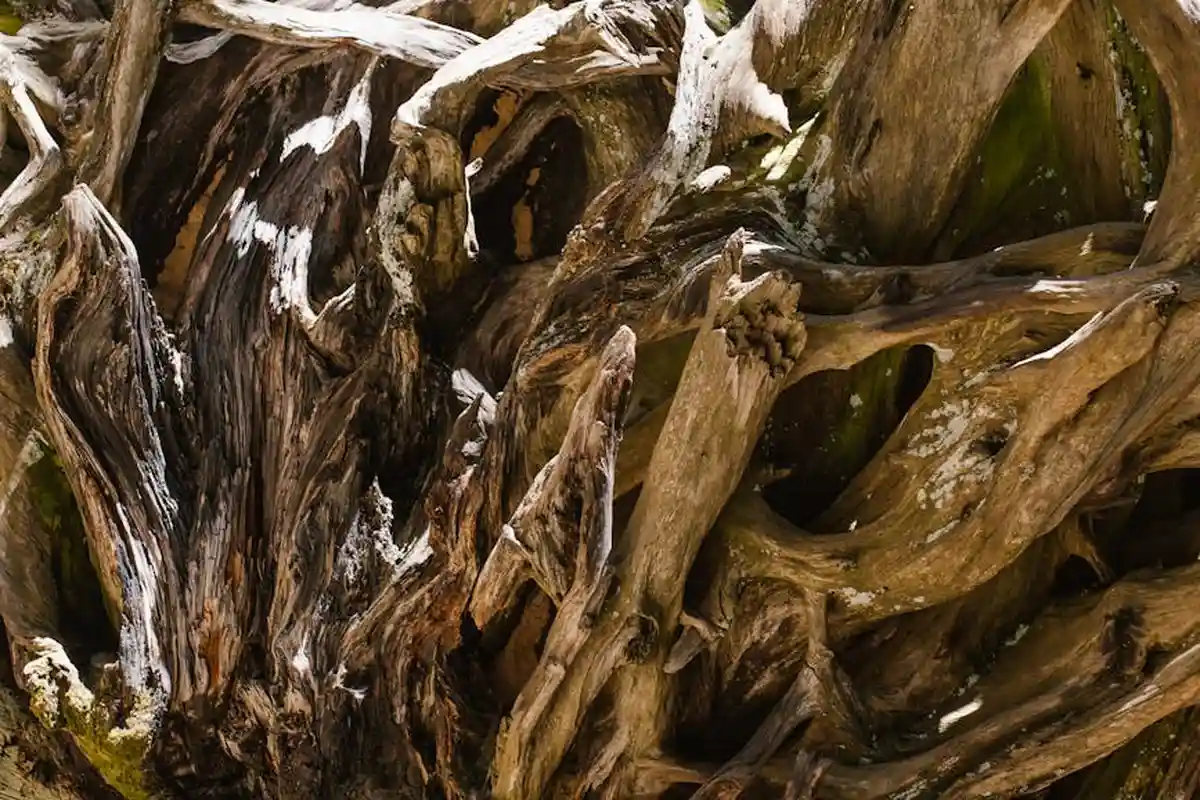
- Burls: These are growth deformities with wildly unpredictable, eyespot-figure. You cannot predict the pattern inside a burl until you slice it.
My best shop tip is to always inspect the end grain first. The pattern you see on that end is a map of the lines that will run along the face of your veneer. A straight, even end grain suggests straight grain on the face. A wavy, swirling end grain promises a spectacular and challenging surface.
Reading the Log: How Sawing Method Dictates Your Veneer
The science tells you what’s in the wood, but the sawyer decides how it’s revealed. Think of a log as a cylinder. How you slice that cylinder is your first and most powerful tool for grain prediction.
We typically talk about three cuts. Flat sawn (or plain sawn) is the most common. The log is sliced parallel to its center. Quartersawn means the log is first quartered, then each quarter is sliced radially, perpendicular to the rings. Rift sawn is similar to quartersawn but at a slight angle to the rays to minimize the appearance of the medullary ray fleck in some species. This sets up the quarter sawn vs rift sawn comparison. The two cuts yield different grain appearances and performance characteristics, depending on the wood species.
The sawing method directly dictates the pattern library you have to work with for veneer matching and inlay design. Choosing the right cut is choosing your starting canvas.
Flat Sawn: The Cathedral Grain Factory
This cut gives you the classic “cathedral” grain pattern-those parabolic arcs. It has the highest yield from a log, making it economical. For veneer work, that means wider, more dramatic sheets. The pronounced seasonal movement is a key factor for veneer stability; a flat-sawn veneer glued to a stable substrate will still try to move more than a quartersawn one, which can affect long-term glue bond integrity. It’s predictable in its boldness, but less predictable in its exact symmetry for matching.
Quartersawn: Predictable Straights and Rays
This is the choice for precision. The grain appears as straight, consistent lines. More importantly, it exposes the medullary rays as beautiful “ray fleck” or “silver grain,” especially in oak. Its dimensional stability and consistent linear grain make quartersawn veneer the ideal choice for precise inlay borders and geometric parquetry where wood movement must be minimized. The pattern is highly predictable, sheet to sheet.
Shop Note: Marking Faces for Grain Consistency
Before you ever resaw a board for veneer or send a flitch to the drum sander, mark the “face side.” This is the surface that was facing the bark or the pith. I use a simple “B” for bark side. Keeping all your veneer slices in sequence and oriented with the same face up is the single biggest step you can take to ensure a perfect bookmatch or slip match later. It maintains the consistent angle at which your knife or saw intersected the growth rings.
The Shop Floor Method: Physical Techniques for Perfect Matching
You can predict wood grain by understanding how a log is cut. The pattern in your veneer or inlay starts at the sawmill. Flat-sawn boards show cathedral grain patterns. Quarter-sawn boards show straight grain with ray fleck. Rift-sawn is somewhere in between. To match grain, you need sequential slices from the same flitch, the same section of log. This is especially important when you stain wood filler to match grain.
The most reliable prediction tool is a sharp blade and a consistent cutting jig.
Book Matching, Slip Matching, and Butt Matching
These are the three core techniques for arranging your slices. Your choice dictates the final symmetry.
- Book Matching: Place two sequential slices side-by-side like opening a book. This creates a mirror-image, symmetrical pattern around the seam. It highlights dramatic cathedral grain or consistent curl. The downside is that any color variation between slices becomes obvious.
- Slip Matching: Place all slices in the same order and orientation they came off the log. The grain pattern flows in one direction, creating a repetitive but shifting image. This is less formal than book matching and better masks minor color differences.
- Butt Matching: Simply place the edges of two slices together without flipping. It’s useful for continuing a grain line across a wide panel, but it often creates a noticeable “jump” in the pattern at the seam where the grain doesn’t perfectly align.
A Simple Slicing Jig
Consistency is everything. For a bandsaw veneer setup, I use a simple tall auxiliary fence with a stop block. After each cut, I slide the stock forward against the stop, maintaining the same thickness. A featherboard keeps pressure consistent. For a table saw, a sled with a fixed stop block and hold-down clamps works. Measure thickness with calipers after every few cuts.
Anecdotal Evidence: When the Wood Talks Back
I once had a flawless-looking walnut board for a guitar top. I planned a book match. The grain was straight and predictable on the face. I made my first slice, and the inner face revealed a wild, swirling tension pattern completely invisible from the outside. The board had internal stress from growing around a branch. My perfect mirror image was ruined.
Always take a “test slice” from the end of expensive stock before committing to your final cut line. Sand it quickly to see the true face grain. This five-minute step can save a hundred dollars in wood.
Building a Physical Grain Reference Library
Your best tool is a collection of real wood samples you’ve processed yourself. Cut small blocks, about 3″ x 3″, from your common species. As you add blocks, consider wood selection and the behavior of different woodturning species to guide future projects. This practice helps you compare texture and workability across species for better results.
- Sand one face through the grits to 220.
- Apply a drop of water or mineral spirits to see the true color and grain. Let it dry.
- Tag the sample with species, source, saw type used (bandsaw, drum sander), and cut orientation (flat, quarter).
This library lets you feel the density and see how light plays on the grain. A digital photo can’t replicate that.
The Paper Trick: A Low-Tech Simulation Method
This is my go-to for inlay design. You need tracing paper and a soft pencil.
- Place the tracing paper over the wood area you plan to use.
- Gently rub the side of the pencil lead over the paper. The grain pattern will transfer like a grayscale rubbing.
- Cut out your traced pattern with scissors.
- Move the paper cutout over your project drawing to visualize the inlay. Flip it for book match effects.
This method gives you a 1:1 physical template that respects the actual, imperfect flow of the grain.
Going Digital: Simulating Grain on Screen Before You Cut
Digital tools don’t replace physical skill. They reduce risk. Think of them as a sophisticated sketchpad that lets you experiment without wasting material. The goal is to answer “what if” before the sawdust flies.
Scanning Reality: The Best Digital Reference
A scan of your actual wood is worth a thousand generated textures. For accurate color and detail:
- Use a flatbed scanner for small samples. A sheet of plain white paper as a background reduces shadow.
- For larger pieces, use a camera on a tripod. Shoot on a cloudy day or in open shade for perfectly diffuse, even light. Avoid flash and direct sun.
- Always include a scale in the image. Lay a ruler or a coin with known dimensions next to your sample. When you import the image into design software, you can scale it to real-world dimensions. This is critical for inlay work.
Simulation Software: What to Look For
You don’t need specialized wood software. A basic image editor with layers works. Key features to use:
- Layers: Place your wood scan on one layer, your inlay design on another. Adjust opacity to see how they interact.
- Mirror and Flip Tools: Instant book match preview. Duplicate your wood layer, flip it horizontally, and align the seams.
- Clone Stamp and Healing Tools: These let you extend a grain pattern or remove a small defect from your digital sample.
- Hue/Saturation Adjustment: See how the wood looks with a darker stain or more amber tone.
Online texture generators can provide a generic wood background. They are useful for broad composition but lack the specific character of your board.
From Texture to Template: The Digital Workflow
Turning a simulation into a cut file is straightforward.
- Finalize your grain image at the correct scale (e.g., 1 pixel = 1 millimeter).
- On a new layer, draw the precise outline of your inlay piece or veneer segment.
- Hide the wood texture layer, leaving only your clean outline.
- Print this outline template at 100% scale. Adhere it directly to your wood blank for cutting.
- Alternatively, save the outline as a vector file (SVG, DXF) for use with a CNC router or laser cutter.
This workflow separates the artistic grain placement from the mechanical cutting task, giving you control at both stages.
From Simulation to Reality: Executing Your Inlay and Veneer Design
Your digital mockup is perfect. Now you must make the first physical cut. This transition is where most projects succeed or fail. Think of your predicted grain pattern as a topographic map. Your tools must follow its contours.
The sequence from design to assembly is non-negotiable. Skip a step, and your seamless match will show a seam.
- Finalize your full-size pattern. Print it or draw it on paper. Never work from a scaled screen image.
- Prepare your wood and veneer. Ensure surfaces are flat and sanded to at least 150 grit.
- Transfer the pattern onto the material using your chosen method (detailed below).
- Cut your pieces, always planning the cut direction around the grain.
- Dry-fit everything with tape before glue touches wood.
Choosing the right cutting tool depends on the job’s complexity. A sharp utility knife is best for straight cuts in thin veneers. For intricate, curving inlay lines, a jewelers’ fret saw gives you control. I use a laminate trimmer with a tiny bit for repeating patterns or cutting the recess in the base wood. For any powered cutting, make multiple shallow passes to avoid tearing out chunks of your carefully selected grain.
Tear-out is the enemy here. It happens when the tool’s force lifts fibers instead of shearing them. To troubleshoot, ensure your blade is razor-sharp. For veneer, place masking tape over your cut line. Cut through the tape and the wood in one score. Backing your workpiece with a scrap board also provides crucial support for a clean exit.
Transfer Techniques: Carbon Paper, Pricking, and More
Accuracy in transfer is accuracy in the final piece. Old-school methods still win for tactile feedback. Carbon paper works, but it can smudge and the line is thick. I prefer the pricking method for critical work. You tape your paper pattern down, then use a sharp pin or awl to poke tiny holes along the pattern lines every 1/16th of an inch.
Lift the paper, and you have a precise dotted line to connect with a fine pencil. For modern ease, spray adhesive lets you temporarily stick a printed paper pattern directly to the wood. You cut through the paper and the wood surface layer. Just be certain to use a low-tack adhesive and clean any residue immediately with mineral spirits.
Cutting with the Grain, Not Against It
Your grain prediction tells you which way the fibers run. Your cutting path must honor that. Always orient your cut so the blade’s leading edge pushes fibers into the solid wood, not out toward the edge of your piece. Imagine combing hair. You go with the lie of the hair, not against it, to avoid snagging.
For a complex inlay shape, break it down into segments. Plan your cuts so you are always moving along the predicted grain direction, even if it means stopping and restarting from a new angle. This prevents the splintering that ruins a delicate point or curve.
The Glue-Up Test: Dry-Fitting for Seamless Matches
Never skip the dry-fit. For veneer matching, use painter’s tape to hinge your sheets together face-up, just like in your simulation. Fold them open and closed, checking the flow of the grain at the seam under your shop lights.
For inlay, place all the cut pieces into their recesses without glue. Use a single piece of clear tape over the entire assembly to hold it flat. This test reveals high spots that need sanding and gaps you might have missed. A five-minute dry-fit can save you from a permanent mistake.
The Final Touch: Finishes and Effects That Make the Grain Pop

Finish is the reveal. It’s the moment your grain prediction proves itself. The goal is controlled enhancement, not disguise. How you treat porous pine is different from tight-grained maple.
Pine has dramatic contrast between its soft earlywood and hard latewood. If your goal is to stain pine to mimic oak grain, you can guide the contrast to read like oak. A simple clear oil like tung oil will soak in unevenly, highlighting this texture beautifully. For a dense wood like maple or cherry, a thin coat of dewaxed shellac seals the surface first, allowing a stain or dye to color more evenly without blotching.
Techniques stack. A stain adds color. A “wash” (thinned paint) can sit in the pores. Clear pore filler (like epoxy) creates a perfectly flat surface for a mirror-like topcoat. Painting a faux wood grain is a separate skill for repair, not for honoring the real material’s structure.
Coloring Wood Grain: Stain, Dye, and the Science of Absorption
Stains use pigments that sit in the wood’s pores and surface scratches. Dyes are microscopic particles that penetrate the wood cell walls. This is why they behave differently. The soft earlywood bands in oak or pine are more porous. They grab more pigment from a stain, becoming darker. The dense latewood resists, staying lighter. This creates the classic contrasting grain pattern.
You cannot predict final color from a can’s lid. You must test on a scrap from the same board. Here’s my method:
- Sand your test piece to the exact grit you’ll use on the project (e.g., 180 grit).
- Apply your stain or dye with a brush. Let it sit for one minute.
- Wipe it off firmly with a clean rag, following the grain direction.
- Let it dry fully. Apply your planned topcoat (like polyurethane) to half the board. The topcoat will darken and enrich the color, showing you the true final look.
Creating a Fake Wood Grain Effect for Repair
This is for fixing a damaged spot on a painted piece or blending a wood filler patch. It’s artistry, not science. Start with a base coat that matches the wood’s lightest color. Let it dry. Mix a glaze (a slow-drying, translucent paint) to the darkest grain color. Brush it over the area.
Immediately, use a graining rocker or a dry, stiff brush to drag through the glaze, creating wavy grain lines. Use a feather to flick in small knots. It relies on observation and practice, not on predicting cellular structure. This decorative technique solves a visual problem, but it doesn’t replicate the true depth or figure of real wood.
Shop Note: The Pine Test Panel
I keep a sanded, clear pine board in my finishing area. Pine’s aggressive grain pattern acts like a loud amplifier for any finish effect. If a stain looks good and even on pine, it will perform flawlessly on a more forgiving hardwood. Test every new product on this panel first. It saves expensive project wood and shows you exactly how a finish will interact with pronounced grain. Properly preparing and finishing pine makes all the difference.
Frequently Asked Questions: Grain Prediction for Veneer & Inlay
1. How does the biological difference between heartwood and sapwood affect veneer matching?
The distinct color and density between heartwood and sapwood, caused by cellular chemical changes, will create a visible demarcation line if both are included in a match. For a seamless appearance, plan your veneer slices to use wood from a single zone or embrace the contrast as a deliberate design element.
2. Why is quartersawn grain more predictable for intricate inlay work than flat sawn?
Quartersawn wood exhibits minimal tangential shrinkage and a consistent linear grain pattern due to its radial alignment to the growth rings. This dimensional stability prevents gaps from forming at inlay seams and provides a uniform background for precise geometric designs.
3. Can digital simulation accurately predict how finish will interact with my chosen grain pattern?
No, simulation cannot replicate the complex capillary action of stains and oils in porous and dense cellular regions. Always perform a physical finishing test on a sanded scrap from the same board to see the true color and contrast enhancement.
4. What is the most critical factor for glue stability when matching veneer over a large panel?
Ensuring the substrate is dimensionally stable and that the veneer’s grain orientation is consistent across all pieces is paramount. Mis-matched grain direction between veneer pieces or against the substrate can create opposing forces that compromise the glue bond over time.
5. How can I predict and manage color variation between sequential veneer slices from the same flitch?
Natural pigment variation exists even within a single log. To manage this, lay out all sequential slices while they are still raw and number them; you can then arrange them to create a gradual, pleasing color gradient or segregate lighter and darker slices for different projects.
Your Grain Simulation Workflow
The most reliable method for predicting wood grain is to combine a hands-on physical analysis with targeted digital simulation. Start by examining your actual wood stock under different lights to understand its true figure and color shifts. Use free digital tools to test pattern repeats and inlay layouts before making a single cut. This hybrid approach saves material and builds your innate sense for how grain behaves, which is the ultimate goal. That same awareness also informs bonding decisions—grain orientation and porosity affect how surfaces will adhere. Considering porosity and grain when you plan joints leads to stronger, more predictable bonds.
Honor the material by sourcing veneers and lumber from suppliers committed to sustainable forestry. Your careful planning to minimize waste is the final, essential step in responsible craftsmanship. Let that practice guide your continuous learning about wood science and design.
Deep Dive: Further Reading
- Telling the Difference Between Wood and Veneer | Laurel Crown Furniture
- Amazon.com: Peachtree Woodworking Supply Veneer Variety Pack for Marquetry and Inlay Work with 15 Square Feet of Domestic •Exotic •Various Grain and Color Dyed Raw Wood Veneers •No Two Packs are Alike : Tools & Home Improvement
- Amazon.com: Juexica 30 Pcs 7.9″ x 7.9″ Wood Veneer Sheets Variety Pack Square Wood Veneers for Marquetry, Inlay, Woodworking Projects, Various Grain and Color : Tools & Home Improvement
- DIY – Easy simulated wood inlay using veneer (aka “fancy plywood”) – Beyond the Manual – Glowforge Owners Forum
- Veneer Inlays
Written by David Ernst. David is a veteran woodworker. He is now retired and stays in his cabin in Wisconsin which he built himself. David has 25+ years experience working in carpentry and wood shops. He has designed and built many small and large wood projects and knows the science behind wood selection like the back of his hand. He is an expert guide on any questions regarding wood material selection, wood restoration, wood working basics and other types of wood. While his expertise is in woodworking, his knowledge and first hand experience is far from 'woody'.