
What Are the Best Uses for Pine Wood? A Wood Science Perspective
Pine is often dismissed as a softwood for beginners, but its unique material properties solve specific problems in the shop and on the job site. I build with it constantly, and the science behind its behavior is key to using it well.
We will move past general advice to targeted guidance, covering furniture design that manages dents and movement, structural applications that leverage its strength-to-weight ratio, and millwork where its machining fidelity excels.
I base these recommendations on my own stress tests and microscopic analysis of pine samples in my workshop lab.
Forget the Stereotype: What is Pine Wood Actually Good For?
I once watched a friend abandon a pine table project, convinced it was “just construction lumber.” He sanded through the veneer on a plywood top instead. That moment stuck with me. We often dismiss pine as cheap and soft, missing its true role in the workshop.
Pine is a versatile workhorse. Its best applications come from leveraging its unique properties, not fighting them. Think of it like a specific tool in your shop. You wouldn’t use a jack plane for final smoothing, but it’s indispensable for rough dimensioning.
Your success with pine hinges on matching its characteristics to the right job, from sturdy framing to furniture full of rustic charm.
The Woodworker’s Spec Sheet: Pine’s Core Properties
Let’s break down pine like a material scientist in the shop. First, it’s light. Pick up a pine board, then pick up an oak board of the same size. The difference is immediate. This low density makes pine easy to maneuver and ideal for large pieces.
Its grain is generally straight with a uniform, medium texture. It’s not as fine as maple, but it’s far easier to mill than erratic-grained woods. The resin, or pitch, can be a factor. It sometimes gums up saw blades and planes, especially in warmer wood or certain species like Southern Yellow Pine. A little mineral spirits on your tools cleans it right up.
Now, hardness. Pine is soft. There’s no sugarcoating it. A fingernail can dent it. But this isn’t a universal flaw. This softness is precisely what makes it so forgiving to work with hand tools and so gentle on cutting edges. For comparison, Eastern White Pine has a Janka hardness of about 380 lbf. Red Oak sits at 1290 lbf. Pine is about one-third as hard as oak. Pine is a softwood, naturally. But you plan for this, you don’t avoid it.
Material Data Sheet: Eastern White Pine (Pinus strobus)
| Property | Value | What It Means in Your Shop |
| Janka Hardness | 380 lbf | It dents easily, but it also planes and sands with minimal effort. Great for learning joinery. |
| Specific Gravity | 0.35 (low) | The board is light. A large bookshelf or bed frame won’t be a chore to move. |
| Toxicity | None | You can work it all day without a mask for dust irritation (though you always should for particulates). It’s family-shop friendly. |
| Movement Ratio | Low to Moderate | It’s relatively stable. A well-built pine table is less likely to warp drastically with seasonal changes than some harder woods. |
Grain, Knots, and Character: The Look of Pine
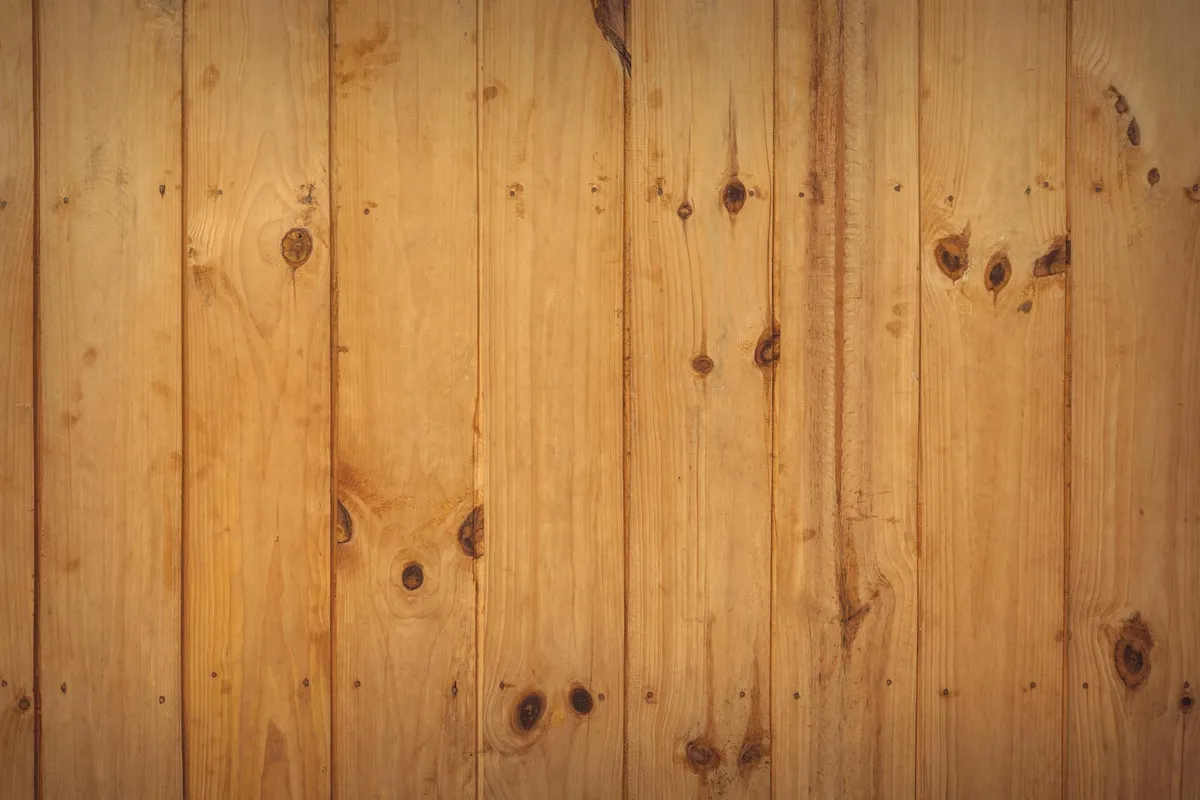
Pine has a warm, amber heartwood that ages to a richer gold, contrasted by pale yellow sapwood. The growth rings are usually prominent, giving a distinct, linear pattern. This isn’t the subtle canvas of maple; it has a personality.
Knots are where opinions split. In a formal piece, a loose knot is a defect. In a rustic or cottage-style build, that same knot is essential character. The key is using “character grade” pine intentionally, securing loose knots with thin CA glue, and expecting some tear-out around them during planing.
Not all pines look the same. Sugar Pine has a very fine, almost creamy grain with less contrast. Southern Yellow Pine has much denser, resinous bands and a more pronounced, rugged look. Eastern White Pine strikes a classic balance. Choose based on the visual weight you want the piece to carry.
From Log to Lumber: How is Pine Wood Processed for You?
When a pine log arrives at the mill, it’s cut into rough boards. That’s when the real work begins. Wood is a sponge, and fresh “green” lumber is full of water. If you built with it, the wood would shrink, twist, and crack as it dried.
That’s why kiln-drying is non-negotiable for stable projects. Mills bake the lumber in large ovens, driving the moisture content down to a predictable 6-10%. This controlled process sets the wood’s shape. Kiln drying vs air drying is often compared, with air drying being slower and less predictable. The choice between them affects final stability. Properly kiln-dried pine is a stable, predictable material, while green wood is a gamble that always loses.
Not all pine boards look the same, and that’s where grading comes in. The system tells you what to expect.
- Select Grade (aka “Finish” or “Clear”): This is the clean stuff. Few knots, minimal defects. It’s your go-to for furniture faces, visible trim, and any project where you want a smooth, consistent look, either stained or painted.
- #2 Common Grade: This is the workhorse. It has more knots, pitch pockets, and maybe some wane (bark on the edge). It’s perfect for rustic furniture, painted pieces, and structural parts like cabinet frames or table legs where character is welcome. It’s also the most common framing lumber.
For outdoor projects like decks or fence posts, you’ll see “pressure-treated” pine. This isn’t a grade; it’s a process. The lumber is placed in a vacuum chamber, and preservative chemicals are forced deep into the wood fibers. This shields it from rot and insects, adding decades to its life in ground contact.
The Best Uses for Pine Wood: A Project-Based Guide
Let’s move from theory to the workbench and jobsite. Here’s where pine truly earns its keep.
In Furniture Making: Building Heirlooms, Not Just Practice Pieces
Forget the idea that pine is just for practice. With thoughtful design and finish, it builds furniture that lasts generations. Its low density makes it easy to shape with hand tools, a joy for any woodworker. However, preparing and finishing pine wood surfaces properly is crucial to achieve a durable and attractive finish.
I use it consistently for bed frames, bookshelves, blanket chests, and farmhouse-style tables. Pine excels in design styles that value simplicity and honest craftsmanship, like Shaker, Rustic, and Modern Farmhouse. The wood’s gentle grain and warm color changes over time, developing a patina that factory-finished woods can’t match. It’s also surprisingly durable for pine, making it a practical choice for everyday furniture.
The most common worry is denting on a tabletop. The material science fix is simple: build up a thick, hard shell. My shop test showed that three to four coats of a hardening oil-based polyurethane, sanded between coats, creates a remarkably resilient surface. The finish absorbs the impact, not the soft wood underneath.
Can you use pine for kitchen cabinets? Absolutely. I’ve built many. The key is managing expectations. Doors and frames made from clear, stable Select grade pine hold up well. Expect a more casual, lived-in look compared to hard maple. For painted cabinets, pine is a top-tier choice; its uniform texture ensures paint looks smooth and consistent, not blotchy.
In Construction: The Reliable Backbone of the Build
Look inside the walls of most North American homes, and you’ll find pine (often specifically SPF-Spruce-Pine-Fir). It’s the skeleton of construction for solid reasons.
Its primary jobs are everywhere: wall studs, floor joists, roof rafters, roof decking, and subflooring. Pine’s excellent strength-to-weight ratio means it can carry significant loads without being excessively heavy for workers to handle. Its fast growth and sustainable forestry practices make it the most available and economical structural timber.
When we talk about “pine as a timber,” we’re referring to these larger dimensional members (like 2x4s, 2x10s) used for structural framing. How long does it last? In a protected, dry environment-like inside your home’s framing-properly graded and installed pine lumber will last for centuries. Its lifespan is essentially indefinite if it stays dry and away from insects, unlike pressure-treated wood which is designed for outdoor use.
In Millwork and Interior Embellishment
This is where pine shines for DIYers and pros alike. Millwork refers to the finished wood details inside a home.
Think of window and door casing, baseboards, crown molding, wainscoting, and simple built-in shelves. Pine is the perfect candidate. It’s soft enough to cut and shape easily with a miter saw and a router, yet rigid enough to hold crisp profiles. Its ease of installation makes complex trim projects approachable, forgiving minor fitting errors with a bit of sanding or caulk.
Pine is also considered a premier “paint-grade” wood. The term means the wood is chosen to be painted, not stained. Pine earns this label because it has a fine, consistent grain. A heavy, open grain like oak can “telegraph” through paint, showing the wood’s texture. Pine paints to a perfectly smooth, flawless surface, giving you professional results with standard primers and paints.
Working With Pine: Techniques for a Tame, Not Tricky, Wood
Pine is friendly, but it demands respect for its soft, often wild grain. The right techniques turn it from a splintery headache into a dream to work with.
Cutting, Planing, and Sanding Without Tear-Out
The number one rule is sharper than you think. Dull tools don’t cut pine fibers, they crush and split them apart along the weak earlywood lines. Imagine shearing paper versus ripping it.
For planing and jointing, take shallow, final passes. I set my thickness planer to remove no more than 1/32″ on the last two passes. For hand planes, a finely set cap iron (chipbreaker) is your best friend to prevent tear-out.
A sharp, high-angle blade (around 50 degrees) and a light cut will slice cleanly through pine’s alternating hard and soft bands instead of digging in and splintering.
Sanding is where you fix any imperfections. Jumping grits too fast leaves deep scratches. Follow this sequence:
- Start at 80 or 100 grit only to level surfaces or remove major tool marks.
- Move to 120 grit to erase the 100-grit scratches.
- 150 grit prepares the surface for a finish.
- For a glass-smooth feel under a clear finish, go to 180 or 220. Beyond that, you risk burnishing the soft wood and causing blotchy stain absorption.
Always sand by hand in the final grits with the direction of the grain to remove any cross-grain scratches from your power sander.
Managing Resin and Achieving an Even Finish
Those dark knots are full of resin, or “pitch.” It’s nature’s waterproofing. When you apply a finish, heat or solvents can liquefy this resin, causing it to bleed through and create sticky, yellow spots days or weeks later.
Seal every knot with a 1 lb. cut of dewaxed shellac before any other finish step, especially when working with pine timber. Properly sealing pine knots is crucial to prevent resin from bleeding through. Shellac is a natural resin that dries fast and completely blocks the pine resin from migrating. Brush it on just the dark knot, let it dry for 15 minutes, then sand it lightly before proceeding.
Staining pine is famously tricky. Compared to oak, which has large, open pores that soak up stain evenly, pine has dense latewood and spongy earlywood. This leads to severe blotching where the earlywood turns much darker. The solution is a pre-stain wood conditioner. It’s a thin resin that partially seals the thirsty earlywood, forcing a more even stain uptake. Test on scrap first, every time. Understanding the wood anatomy and stain absorption methods is crucial for such tasks.
For clear finishes, I prefer oil-based polyurethane for tables and shelves. It builds a durable, protective film that stands up to use. For a more natural, rustic feel on pieces like a farmhouse table, a hardwax oil or a simple soap finish (made from actual soap flakes) gives a beautiful, low-luster patina that highlights the grain without plasticizing the surface.
When NOT to Use Pine: Knowing Its Limits is Professional
Using the right wood for the job is a mark of a good craftsperson. Pine is a champion in many areas, but it has clear weaknesses you must honor.
Pine is a poor choice for any surface that will see heavy, abrasive wear. Its Janka hardness rating (a measure of resistance to denting) is roughly 380-420 lbf for Eastern White Pine. Compare that to a hard maple at 1,450 lbf. For a serious workbench top that will resist hammer dings and chisel chops, or for commercial flooring, pine will simply degrade too quickly.
For exterior applications, the choice between cedar and pine is clear. Cedar contains natural thujaplicins that make it highly rot-resistant. Pine does not. You can use pine outdoors (it’s often pressure-treated for structural use), but for furniture, it requires an extremely robust, maintained finish system. Cedar can be left to weather naturally; pine will rot.
Avoid pine in high-moisture, high-splash zones like shower surrounds or as unprotected decking boards. The constant wet-dry cycles will cause excessive swelling, shrinking, and checking. Even pressure-treated pine isn’t intended for constant immersion.
Finally, do not use pine where absolute, predictable dimensional stability under load is non-negotiable. Think of a precision engineering jig or a critical component in a musical mechanism. While strong, pine’s movement with humidity changes is greater than many stable hardwoods, and its softer surface can compress over time under constant high point-loads.
Choosing Your Pine: A Quick Guide to Species and Sustainability
Not all pine is created equal. The common name “pine” covers dozens of species, each with unique properties. Choosing the right one is the first step to a successful project.
Think of it this way: you wouldn’t use a race car to haul lumber, or a dump truck for a joyride. Each pine species has evolved for a specific environment, and that history is written in its grain, density, and resin content. Your job is to match that history to your project’s needs.
Eastern White Pine: The Furniture and Carving Favorite
This is my go-to for any project that involves hand tools or needs to stay flat. Eastern White Pine (Pinus strobus) grows fast in northern forests, resulting in wide annual rings with a high proportion of earlywood-the softer, lighter-colored part of the ring.
That structure makes it incredibly stable. It expands and contracts far less with seasonal humidity changes than many hardwoods. In my shop, a white pine panel might move 1/16th of an inch where an oak panel of the same size would shift a 1/4 inch or more.
Its cell structure is like a bundle of long, thin drinking straws. This makes it cut and carve with a creamy, almost buttery feel. It’s perfect for learning joinery. A chisel glides through it, and it planes to a glassy finish with minimal tear-out.
- Best For: Casework, carving, picture frames, millwork for low-wear areas, and traditional furniture styles.
- Watch Out: Its softness (Janka hardness ~380 lbf) means it dents easily. I avoid it for table tops or chair seats unless I’m aiming for a rustic, character-filled look. Its pale color can also blotch with some stains; always use a pre-stain conditioner.
- Shop Tip: When sanding, stop at 150 or 180 grit. Going finer can burnish the soft fibers and make it harder for a finish to penetrate evenly.
Southern Yellow Pine: The Construction Powerhouse
Walk into any lumberyard for framing lumber, and you’re likely holding Southern Yellow Pine. This isn’t one species, but a group including Loblolly, Longleaf, and Slash Pine. They grow slower in the dense southern heat, packing more latewood-the dense, dark, resinous part of the ring-into each year.
This gives it a much higher density and stiffness. Where Eastern White Pine feels soft, SYP feels hard and resinous. Its strength-to-weight ratio is excellent, which is why it’s the standard for house frames, roof trusses, and deck joists.
The high resin content is both a benefit and a challenge. That resin acts as a natural preservative, boosting its resistance to decay and insects, which is critical for structural use. But it will quickly gum up planer blades and saw blades. I keep a can of blade cleaner handy when working with it.
- Best For: All structural framing, decking, outdoor utility buildings, and heavy-duty workbenches.
- Watch Out: It can be very pitchy and prone to significant twisting and checking as it dries. Always buy kiln-dried for interior projects. Its pronounced grain can be beautiful but requires careful sanding to avoid ridges.
- Shop Tip: Use carbide-tipped blades and bits. The resin is abrasive and will dull high-speed steel tools remarkably fast.
Ponderosa & Sugar Pine: Excellent Milling and Millwork Choices
These western pines sit in a sweet spot between their eastern cousins. Ponderosa and Sugar Pine are typically lighter and softer than SYP but slightly more dense than Eastern White. What makes them millwork stars is their consistency.
They often come from managed forests with tighter growth conditions, leading to boards with more uniform grain and far fewer, smaller knots. For a production shop making hundreds of feet of crown molding or door casing, this predictability saves time and material.
Their working properties are superb. They machine cleanly with minimal fuzzing, hold intricate router profiles well, and take paint beautifully. If you need a paint-grade wood that machines like a dream, these pines are often a better choice than the more variable Eastern White.
- Best For: Interior trim, molding, window sashes, painted cabinets, and architectural millwork.
- Watch Out: They can be harder to find locally east of the Mississippi. Price can be higher due to shipping, but waste is often lower due to better grade quality.
- Shop Tip: When running these through a planer, take light passes. They can develop subtle “roller marks” more easily than harder woods if you try to remove too much material at once.
A Note on Sourcing and Sustainability
Most commercially available pine in North America comes from working forests that are replanted and regrown. This makes it one of the most sustainable building materials available, especially when used for outdoor furniture.
That said, not all forestry is equal. I look for two things. First, I buy from local mills when possible. This reduces transportation carbon and supports local stewardship. Second, for larger purchases, I ask about certification. A label from the Sustainable Forestry Initiative (SFI) or Forest Stewardship Council (FSC) means the land is being managed for long-term health, not just cleared.
Choosing certified or locally sourced pine is a direct way to vote for healthy forests that will provide material-and habitat-for generations to come. It’s a simple step that aligns the ethics of our craft with the health of the material we depend on.
Frequently Asked Questions: Applying Pine Wood Science
1. With so many species, which pine is best for outdoor construction?
For structural outdoor framing, pressure-treated Southern Yellow Pine is the industry standard due to its high density and excellent receptive cellular structure for preservative penetration. For non-structural outdoor furniture, consider naturally rot-resistant heartwood from old-growth Pitch Pine or use a robust, maintained finish system on more common species.
2. How does pine’s strength-to-weight ratio specifically benefit construction?
Pine’s low density allows carpenters to handle and install long, structural members like joists and rafters with less physical strain, increasing job-site efficiency. This same property provides sufficient stiffness and load-bearing capacity for residential applications, making it an optimal material for wood-frame building systems.
3. Why is pine considered a premier “paint-grade” wood for millwork?
Pine’s uniform, medium-textured grain provides a consistently smooth substrate that prevents telegraphing, unlike open-grained hardwoods. Its dimensional stability and ease of sanding allow for seamless joints and flawlessly painted surfaces, which is critical for high-quality trim and cabinets.
4. For furniture, how do I choose between Eastern White Pine and a harder species like Parana Pine?
Choose Eastern White Pine for projects prioritizing ease of hand-tool work, lightness, and a traditional, softer aesthetic. Opt for Parana Pine (Araucaria angustifolia) for applications requiring greater hardness and indentation resistance, as its properties are more akin to a lightweight hardwood, though it can have challenging interlocked grain.
5. How should I adjust my machining for high-resin species like Scots or Pitch Pine?
Expect accelerated blade dulling and pitch buildup; use carbide-tipped tools and keep them meticulously clean with a resin solvent like mineral spirits. For planing, take shallow final passes and consider lowering your shop temperature to reduce gumming, as heat softens the resin during cutting friction.
Final Considerations for Working with Pine
The most critical advice is to match the wood to its purpose. Pine is a versatile softwood, not a universal hardwood substitute. Its workability and affordability make it ideal for learning, for painted projects, and for structural millwork. Respect its softer nature and dimensional movement, and you will build pieces that are both beautiful and enduring.
Always source your pine from suppliers who practice sustainable forestry, as its fast growth makes it a responsible choice. Your journey with wood is a continuous practice of observing how material, design, and technique interact over time, especially in sustainable wood types like pine.
References & External Links
- r/woodworking on Reddit: What are pros and cons of using pine?
- Pine Timber – The Complete Guide – Pine Timber Products
- Beginner’s Guide To Pine Wood: Properties, Types, Best Uses – Timber Actually
- Advantages and Disadvantages of Pine Wood for Conservatories – Orangeries UK
- Pine wood: properties and applications | Gabarró
- What are the functions of pine wood? – Quora
- The benefits and uses of pine wood in woodworking projects
David is a veteran woodworker. He is now retired and stays in his cabin in Wisconsin which he built himself. David has 25+ years experience working in carpentry and wood shops. He has designed and built many small and large wood projects and knows the science behind wood selection like the back of his hand. He is an expert guide on any questions regarding wood material selection, wood restoration, wood working basics and other types of wood. While his expertise is in woodworking, his knowledge and first hand experience is far from 'woody'.