
How Can You Source Genuine Mahogany and Correctly Identify Exotic Woods?
You found a beautiful board labeled ‘mahogany,’ but is it the genuine article? Misidentification can turn a premium project into a costly lesson.
This article breaks down the process using both shop wisdom and materials science. We will cover the definitive grain and pore structure of mahogany, reliable methods for vetting wood sources and their certifications, and the simple density and hardness comparisons that expose imposters.
I base this guidance on years of milling and testing wood samples in my shop, matching physical performance to anatomical features under the microscope.
What “Mahogany” Actually Means (Clarifying the Confusion)
You’ve probably been here before. You order “mahogany” for a project, but the boards that arrive look, feel, and work nothing like the classic mahogany you’ve read about. The term “mahogany” on a sales ticket is often a description of color, not a guarantee of species. It’s the lumber industry’s most successful and frustrating marketing trick, especially when you expect the real thing.
The only wood that should be called genuine mahogany comes from trees in the Swietenia genus, primarily Swietenia macrophylla, also known as Honduran or Big-leaf mahogany. This is the dense, stable, rosy-brown wood used for centuries in fine furniture and boatbuilding. When someone asks ‘what tree produces mahogany wood,’ this is the only botanically correct answer.
Most wood sold as mahogany is something else. Here are the common substitutes:
- African Mahogany (Khaya spp.): A good, widely available furniture wood. It’s typically lighter in weight and has a more pronounced, interlocked grain that can tear out during planing.
- Philippine Mahogany (Lauan/Shorea spp.): This is a common plywood core material. It’s a much softer, lightweight hardwood from a different family entirely.
- Sapele (Entandrophragma cylindricum): A beautiful wood with a distinctive ribbon stripe. It’s harder and denser than true mahogany, and its interlocked grain makes it challenging to hand-plane without tearout.
These woods are not bad. They’re just different. Using them expecting Swietenia’s buttery workability and stability leads to shop headaches. There’s a bigger issue, though. True Swietenia mahogany is listed on CITES (the Convention on International Trade in Endangered Species). This means its international trade is heavily regulated to prevent over-exploitation. If a seller can’t or won’t discuss the origin and CITES documentation of their “genuine mahogany,” you are almost certainly looking at a substitute species. Sourcing ethically isn’t just good practice; it’s central to finding the real thing.
How to Source the Real Thing: A Step-by-Step Plan
Think of this as a detective mission. Your goal is to find Swietenia macrophylla. The answer to ‘where can i buy mahogany wood’ is never a simple store name. It’s a process of verification.
Step 1: Find the Right Dealer
Forget big-box stores. You need a specialty hardwood dealer. Search online for “hardwood lumber dealer” or “exotic woods” near me. Reputable online retailers are also an option, but for a first purchase, a local yard you can visit is best. These dealers survive on their reputation with skilled woodworkers and are your strongest ally.
Step 2: Ask the One Question That Matters
Your first and most important question is not about price. It’s this: “What is the botanical name for this wood?” An honest seller will immediately say “Swietenia macrophylla” and should be able to show you the name on an invoice or grading ticket. Vague answers like “It’s genuine African mahogany” are a clear red flag. This step is the core of how to source genuine mahogany wood.
Step 3: Know the Real Price
Genuine mahogany commands a premium. In walnut vs mahogany woodworking, cost is only part of the picture. Workability and finish also matter. As a rough benchmark, expect to pay at least 1.5 to 2 times more per board foot than for African mahogany. If the price seems too good to be true, it is. You are either looking at a substitute or wood of very poor quality. Factor this cost into your project from the start.
Step 4: The In-Person Inspection (Your Shop Toolkit)
If you can visit the yard, bring a small toolkit. Your eyes and hands are your best sensors.
- A Hand Plane or Sharp Chisel: Ask to take a thin shaving from the end of a board. True mahogany planes with a crisp, almost waxy feel, leaving a smooth surface with minimal tearout. Khaya and Sapele often feel stringy and resist clean cutting due to interlocked grain.
- Sandpaper (220-grit): Sand a small spot. Genuine mahogany sands to a very fine, almost powdery dust that is pale tan. Some substitutes produce a stringier dust.
- A Pocket Scale: Weigh a sample. Swietenia has a medium density (about 37 lbs per cubic foot). It should feel substantial but not overly heavy like Sapele, nor as light as Lauan.
Finally, look at the end grain under good light. Genuine mahogany has a uniform, medium texture with distinct but not gigantic pores. It looks consistent and orderly, not wild or wildly variable. Trust the combination of correct naming, sensible price, and the evidence from your hands-on tests, including understanding wood anatomy and stain absorption methods. This method separates hope from certainty in your lumber stack.
Your Hands-On Exotic Wood Identification Checklist
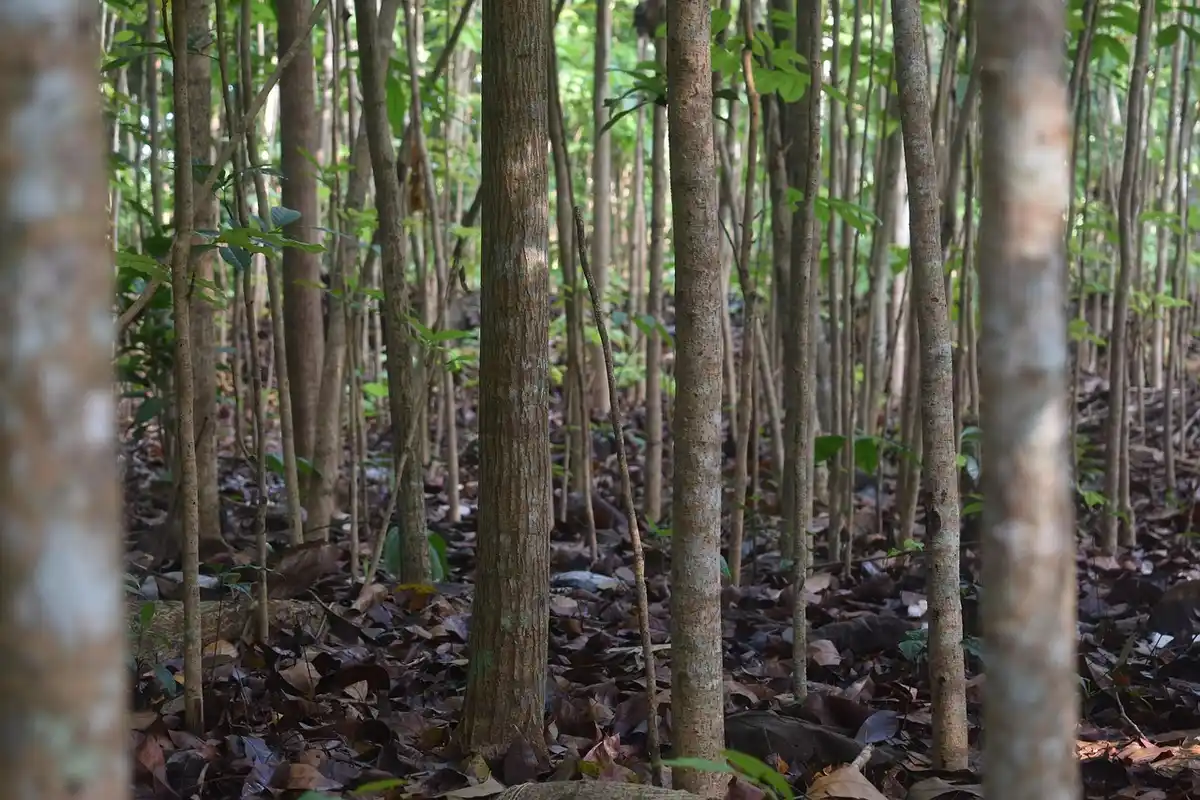
Forget guessing from a photo. Accurate identification happens in your hands. This checklist uses your senses, just like a woodworker in the shop.
Sight
Look closely. Start with the end grain if you can. The pattern here is like a fingerprint.
Grain pattern tells a story of how the tree grew. Ribbon stripe or “roey” figure happens in woods like Sapele, where interlocked grains reflect light differently. Fiddleback figure is a tight, consistent ripple common in maple but also present in some mahoganies. Don’t rely on color alone, it fades.
Check the pores. Oaks have large, open pores you can feel. Maple has closed, tight pores. Most true mahoganies have small to medium, open pores. Sapwood and heartwood contrast can be a clue. Genuine mahogany has a pale sapwood sharply distinct from its reddish heartwood. Utile has less contrast.
Heft and Feel
Pick it up. Density, called specific gravity, is a massive clue. I keep a small sample of a known wood, like red oak, on my bench for comparison when identifying wood species by grain and density.
Weigh the mystery board against your known sample of similar size. Is it noticeably heavier or lighter? African Mahogany (Khaya) feels lighter and softer than Genuine Mahogany. Cocobolo feels like a rock. Your hands are good scales.
Run your thumb across the surface. Does it feel coarse (open pores) or like glass (closed pores)?
Smell and Sound
Your nose is a powerful tool. Freshly planed or sanded wood releases its true scent.
Genuine Mahogany has a faint, neutral scent. Sapele has a distinct, cedary smell. Cocobolo smells spicy, like perfume. Spanish Cedar smells like a pencil box. A characteristic smell can confirm an identification when visual clues are close.
For the experienced ear, tap tone matters. A dense, dry hardwood like rosewood has a bright, clear “ping.” A lighter wood has a duller “thud.” This takes practice but is useful for judging internal integrity too.
The Shavings and Sanding Test
This is the ultimate shop test. Take a sharp hand plane or a very sharp router bit and make a cut.
Does the wood plane cleanly into shiny, cohesive shavings? Good. Does it tear out or crumble? The grain might be interlocked or brittle. Genuine mahogany planes beautifully. Sapele can tear if your iron isn’t razor sharp.
Look at the sanding dust. This is a final check. Brazilian Rosewood dust is often a chocolate brown. Purpleheart dust is a pale tan, not purple. Cocobolo dust is a bright orange powder that will make you itch. Always wear a respirator for this step.
Technical Spec Sheet: Mahogany vs. Common Lookalikes
This table puts numbers to the feel. Janka hardness measures side hardness (in lbf). Specific gravity compares density to water. Use this to cross-reference what your senses tell you, especially when working with different wood species in your projects.
| Common Name | Botanical Name | Janka Hardness (lbf) | Specific Gravity | Working Notes | Sustainability Status |
| Genuine Mahogany | Swietenia macrophylla | 900 | 0.55 | Low blunting, minimal tearout. Classic “true mahogany” workability. | CITES Appendix II. Trade is heavily regulated. Verify legality. |
| Sapele | Entandrophragma cylindricum | 1,410 | 0.67 | Can tear on quarter-sawn faces. Blunts tools moderately. Distinct cedar scent. | Widely available, often FSC-certified. A good sustainable alternative. |
| Khaya (African Mahogany) | Khaya spp. | 1,070 | 0.55 | Softer than Genuine, can have fuzzy surfaces. Easy to work. | Some species are vulnerable. Seek FSC-certified stock. |
| Utile | Entandrophragma utile | 1,210 | 0.62 | Works like Sapele. Sometimes marketed as “Sipo.” | Similar to Sapele, check for certification. |
| Cocobolo | Dalbergia retusa | 2,960 | 0.99 | Extremely dense. Dust is a severe respiratory and skin irritant. Oils can hinder glue adhesion. Stunning orange/black grain. | CITES Appendix II. Heavily restricted. Very rare and expensive legally. |
The Ethics of Your Purchase: Why Documentation Matters
Identifying the wood correctly is only half the job. Knowing where it came from completes it. Ethical sourcing and accurate identification are inseparable.
A well-documented board is a guaranteed board. The paperwork isn’t red tape. It’s a chain of custody that proves the wood was harvested legally from a well-managed forest. It confirms you’re getting the species you paid for.
Let’s decode the stamps and papers.
- FSC (Forest Stewardship Council): This is the gold standard. It means the forest is managed for long-term health, wildlife is protected, and workers’ rights are upheld. An FSC tag on a board of Sapele gives you confidence.
- CITES (Convention on International Trade in Endangered Species): This is a permit, not a sustainability certificate. Appendix I means no commercial trade. Appendix II, which covers Genuine Mahogany and Cocobolo, means trade is allowed only with strict permits proving legal harvest. No CITES papers for these woods means they are almost certainly illegal.
- Legal Provenance: Reputable suppliers can provide documentation back to the country and sometimes the region of harvest. For domestic woods, this might be a simple declaration of origin.
Buying verified wood does two things. It protects vanishing species and complex forest ecosystems. It also ensures the craft has a future with these remarkable materials.
Ask for proof. A simple question separates good dealers from the rest. When you call or visit, say: “I’m trying to source my materials responsibly. Can you tell me about the certification or origin documentation for this lot?”
A quality dealer will have this information readily available and will respect you for asking. If they get defensive or vague, take your business elsewhere. Your demand for clean wood supports the good actors and pushes the entire market toward transparency.
When You Can’t Get Genuine Mahogany: Smart Wood Substitutions
Genuine mahogany, from the Swietenia genus, is a benchmark for good reason. Its stability, workability, and rich color are hard to beat. But its story has changed. Today, it is CITES-listed, often expensive, and its provenance can be ethically murky. You might not find it at your local yard, and that’s okay. The best substitution isn’t about finding a perfect twin. It’s about matching the wood’s properties to your project’s specific needs. Comparing genuine and imitation mahogany helps understand what qualities matter most.
A Property-Based Substitution Guide
Forget searching for “mahogany-like” wood. Instead, ask what you need the wood to do. This approach, based on material properties, leads to better project outcomes, especially when sourcing hickory wood for furniture.
For Color and Grain Match: Sapele or African Mahogany
If you’re building a period reproduction or need a visual match for a repair, your best bets are woods that share mahogany’s visual DNA. Sapele and African Mahogany (Khaya) are both in the same botanical family as genuine mahogany, Meliaceae. This gives them a similar reddish-brown heartwood and chatoyant ribbon stripe figure—unlike pine or hickory which differ significantly in color and grain.
Sapele is denser and harder than genuine mahogany, making it more durable for things like tabletops, but its interlocked grain can cause tearout during planing. I always take lighter cuts and use a sharp, high-angle blade. Khaya is generally closer to genuine mahogany in density and workability, but its color can be more variable, sometimes with a pinkish or grayish cast.
Practical tip: Check the end grain. Sapele’s interlocking grain pattern is usually visible as alternating light and dark bands running in different directions.
For Stability and Rot Resistance: Spanish Cedar
This is the go-to secret for boatbuilders and cigar humidor makers. Botanically named Cedrela odorata, it’s another Meliaceae family member. Its genius lies in its dimensional stability and natural rot resistance, thanks to aromatic oils. While its color is paler (pinkish-tan), it ages to a silvery gray if left unfinished and works beautifully with hand tools.
Spanish Cedar’s low density and straight grain make it incredibly stable, often outperforming genuine mahogany in environments with big humidity swings. I’ve used it for exterior door core stock and lining for blanket chests. Just know its distinct, spicy scent will fill your shop, but you can check out the full profile of its properties to understand why it’s such a popular choice.
The New World Classic: American Black Cherry
For furniture makers in North America, my first recommendation is often Cherry. It’s a domestic hardwood with a legacy as rich as any imported timber. Freshly milled, it’s a light pinkish-brown, but here’s the magic: it darkens dramatically with exposure to light, deepening to a rich, warm reddish-brown over months and years.
Cherry’s aging process gives a piece a living history, something you don’t get with a pre-stained wood. Its workability is superb—it planes, sands, and carves with a clean, predictable feel. It’s also more available from sustainable, managed forests in the U.S. and Canada. The main difference is grain. Cherry has a smoother, finer texture and smaller pores than the more open-grained mahogany, which affects how it takes stain and finish.
The Stain Route: A Practical Compromise
Sometimes, the budget or project scope points towards a common wood like alder or poplar, stained to mimic mahogany. It can work, especially for painted projects where you want a toned undercoat or for pieces that won’t see close inspection.
The limitation is in the grain. Mahogany’s large, open pores are a key visual cue. Alder has a subdued grain; poplar has green and purple mineral streaks. A pore filler and a skilled staining job with a dye (to color the wood) followed by a pigment stain (to sit in the pores) can approximate the look. For a woodworker developing their skills, this process teaches more about finishing than any other method, but it rarely fools an experienced eye. It’s a solution for color, not for replicating the material’s inherent structural or working properties.
Frequently Asked Questions: Sourcing and Identification
How can I verify the CITES documentation for a regulated species like genuine mahogany?
A legitimate supplier must provide a valid CITES Appendix II permit that tracks the wood from the forest of harvest. Treat any inability to produce this documentation as a major red flag, as it often indicates illegal or misidentified wood.
Why do woods like Sapele tear out during planing, unlike genuine mahogany?
Sapele’s interlocked grain structure causes alternating grain directions that a cutting tool must shear through, leading to tearout. Genuine mahogany’s typically straight, uniform grain allows for smooth, continuous shavings with minimal resistance.
When is the higher cost of genuine mahogany truly justified for a project?
Justify the cost when your design requires its exceptional dimensional stability for large panels or its historically accurate, consistent workability for traditional hand-tool methods. For purely visual projects, a sustainable substitute like Sapele is often a more practical and ethical choice.
How reliable are common wood names when identifying species?
Common names are highly unreliable as they are marketing terms, not scientific identifiers. Always ask for and verify the wood’s full botanical name (genus and species) on the invoice or grading ticket for an accurate identification.
What is the single most definitive shop test to separate similar-looking species?
Combining a planing test with end-grain examination is most definitive. The way a wood reacts to a sharp blade (smooth vs. stringy shavings) and its pore structure under magnification provide conclusive, complementary evidence of its anatomical identity.
Putting Knowledge into Practice in Your Shop
The core of sourcing genuine wood is treating every purchase as an investigation. I never rely on a seller’s word or a wood’s color alone. Your most reliable method is to examine the wood’s end grain under magnification and compare its specific gravity to published data for the species. Combining this hands-on verification with paperwork like an FSC certificate is how you build projects with confidence and a clear conscience.
Owning a piece of exotic wood carries the responsibility to honor its origin by using it thoughtfully and wasting none. The science of wood identification and sustainable forestry is always advancing, so make a habit of learning from new research and trusted craftsmen.
Industry References
- Mahogany – Wikipedia
- How to Identify Mahogany Wood – Colour, Grain & Tips
- How to Identify Mahogany Wood | Laurel Crown Furniture
- Mahogany Mixups: the Lowdown | The Wood Database
- African Mahogany Hardwood Identification Guide
Written by David Ernst. David is a veteran woodworker. He is now retired and stays in his cabin in Wisconsin which he built himself. David has 25+ years experience working in carpentry and wood shops. He has designed and built many small and large wood projects and knows the science behind wood selection like the back of his hand. He is an expert guide on any questions regarding wood material selection, wood restoration, wood working basics and other types of wood. While his expertise is in woodworking, his knowledge and first hand experience is far from 'woody'.