
Why Do Some Woods Sink? The Simple Physics of Wood Density
If you’ve ever built a boat or a bath caddy, you know that picking the wrong wood can lead to a sinking feeling, literally. The answer isn’t magic; it’s basic materials science that every woodworker can use.
This article breaks down the practical science behind buoyancy, covering what wood density really means, how to easily tell if your stock will float, and why this matters for your next project’s durability and design.
I’ve personally tested buoyancy across species in my shop, linking hands-on results to the core principles of materials science.
Executive Summary: The Quick Answer to Wood and Water
Here is the core rule you need. Wood floats if its average density is less than that of water. Wood sinks if its average density is greater. Water’s density is 1 gram per cubic centimeter (g/cm³). It is the universal benchmark.
Think of it like a block of foam versus a block of steel in your shop bucket. The foam is full of air pockets and easily floats. The solid steel sinks immediately. Different woods exist on that same spectrum between foam and steel.
The terms “hardwood” and “softwood” are botanical classifications, not reliable guides for predicting if a wood will sink. Balsa is a hardwood but is famously light and buoyant. Southern Yellow Pine is a softwood that can be quite dense. You must look at the measured density of the specific piece rather than relying on hardwood or softwood classifications.
Finally, a wood’s moisture content is the biggest wildcard. The air inside the wood’s cells is what gives it buoyancy. Replace that air with water, and you change the entire equation. This is why understanding the science matters for your projects.
The Shop Science: How Density and Buoyancy Decide Sink or Float
Let’s translate the physics into shop language. An object floats when the upward push from the water equals the downward pull of the object’s weight. It pushes aside, or displaces, a volume of water. If the weight of that displaced water is equal to or greater than the object’s own weight, it stays afloat.
Density is simply how much “stuff” is packed into a given space. Imagine two blocks, each exactly one foot square. One is balsa, the other is white oak. The oak block feels heavy and solid because it packs more wood cell walls into that cubic foot. It has a higher density.
Woodworkers use a handy number called specific gravity. It is the density of the wood compared to the density of water. A specific gravity of 0.5 means the wood is half as dense as water. Any specific gravity below 1.0 means the wood should float in pure water; any number above 1.0 means it will likely sink.
This explains why wood floats in water. Wood is not a solid mass. It is a porous matrix of cellulose cell walls surrounding hollow spaces (lumina). When dry, those spaces are filled with air, dramatically lowering the block’s overall average density below that of water.
This also answers a common shop question: does wood float in oil? Most common oils, like mineral spirits or linseed oil, have a density of about 0.8 to 0.9 g/cm³. They are less dense than water. A wood block with a specific gravity of 0.85 would float in water but sink in these oils, because it is now denser than the fluid surrounding it.
Buoyancy 101: The Rule of Displacement
Try this in your shop. Take a known scrap of wood, say a piece of kiln-dried maple. Weigh it on your scale. Then, slowly lower it into a container of water until it is just submerged, and mark the new water level. The volume of water between the two levels is the volume your wood displaced.
Archimedes’ principle, in woodshop terms, is the water fighting back. The force of that displaced water pushing upward is your buoyant force. If that force matches the weight of your wood scrap, the scrap will float right at the surface. If the wood is too dense, its weight wins, and it sinks.
Wood’s Cellular Pump: Why Air Pockets Are Key
Under a microscope, wood looks like a bundle of microscopic straws. These are the tracheids and vessels that move water when the tree is alive. In your lumber, these tubes are mostly empty. They hold air.
Think of a cellulose sponge. A dry sponge tossed in a sink floats high. Soak it completely, and it sinks to the bottom. The same exact sponge material. The difference is not the material itself, but what fills the spaces inside it. Water replaces the air, and the overall density increases past the tipping point. This is exactly what happens to “sinker” logs or waterlogged lumber.
Oil vs. Water: Does Wood Float in Oil?
This has practical implications for finishing. Say you have a piece of black walnut, with a typical specific gravity around 0.55. It floats high in water. Now, submerge it in a tub of linseed oil (density ~0.93 g/cm³).
It will likely still float, but much lower in the oil. The buoyant force is weaker because the displaced fluid (oil) is lighter. A denser wood, like some pieces of hard maple (SG 0.63), might barely float in water but will sink in that same oil.
You can see this yourself. Take a small, narrow container. Add water to one side and mineral oil to the other. Drop in a few small offcuts of different species. Watch how they behave differently in each liquid. It is a perfect demonstration of how the fluid’s density changes the game.
What Makes Wood Dense? It’s Not Just About Hard or Soft
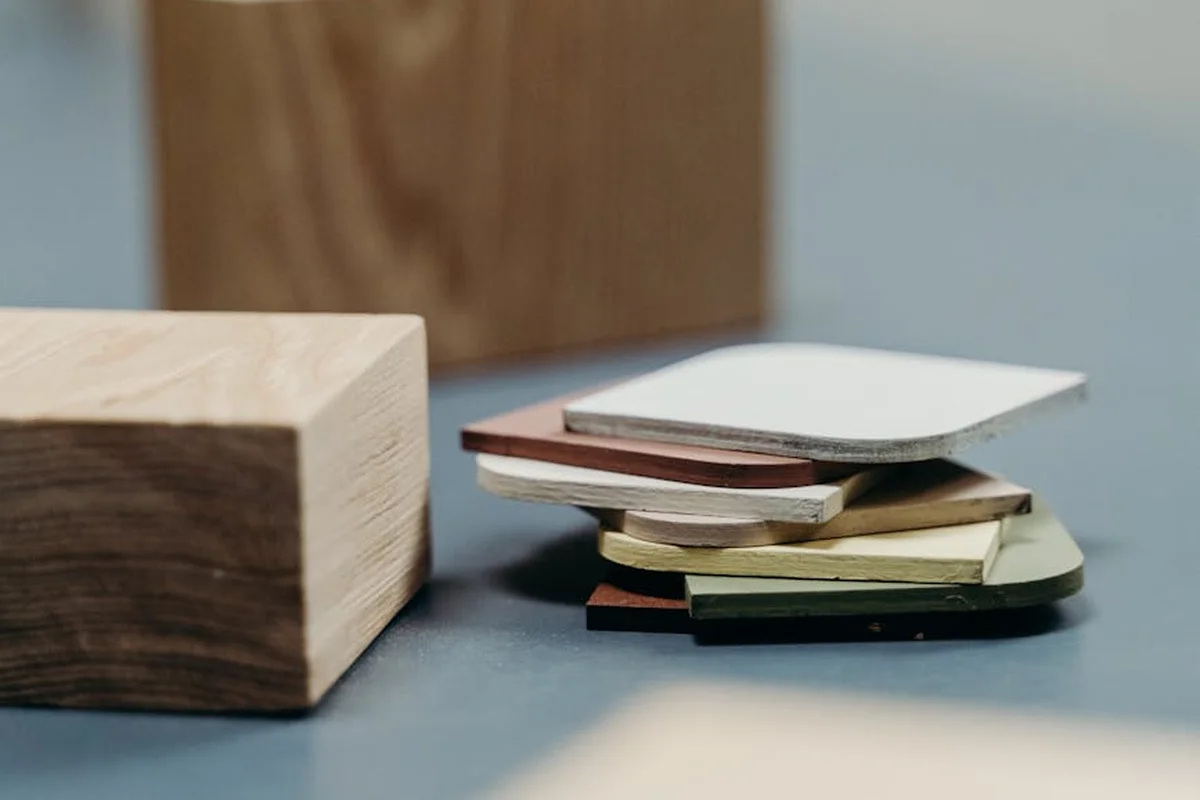
Density determines if wood floats or sinks, but it’s not as simple as “hardwood vs. softwood.” Four main factors control a wood’s density: tree species, growth speed, part of the tree, and moisture content.
Forget the hardwood/softwood label when guessing density. Balsa is technically a hardwood, yet it’s famously light. Yew is a softwood but is dense enough for bows. The real test is specific gravity, a number comparing the wood’s density to water’s.
Moisture content dramatically affects the number on your scale and the result of a sink test. “Green” wood is full of water and can be over twice as heavy as dry lumber. When we ask “does wood float,” we’re almost always talking about dry, ready-to-use shop wood.
Species and Genetics: The Blueprint for Density
Genetics sets the baseline. A slow-growing white oak tree packs more wood fiber into each growth ring than a fast-growing southern yellow pine. This makes the oak denser. I’ve milled both from the same property and the weight difference is obvious.
Even within a species, soil quality and climate cause variation. A sugar maple growing in poor, rocky soil will grow slower and produce denser wood than one in rich, moist soil. This is why density charts give a range, not a single number.
Heartwood vs. Sapwood: Density Changes from the Inside Out
When you cut into a log, you’re cutting through two different materials. The outer sapwood, which transports water, is often lighter and softer. The inner heartwood, filled with resins and minerals for durability, is usually denser.
This means two boards from the same log can have different buoyancy. A sapwood board from a black walnut might float, while a heartwood board from the same tree might sink. For consistent projects, I try to keep my parts from the same general area of the log.
The Moisture Factor: Green Wood vs. Kiln-Dried Wood
Think of fresh “green” wood like a sponge. Its cell walls are saturated, and its cell cavities are full of free water. This extra water weight pushes its density well above water’s, so most green wood will sink.
Kiln drying removes almost all the free water from the cell cavities, leaving air. A properly dried board’s density reflects the wood fiber itself, which for many species is lighter than water. That’s why a dry pine board floats while a wet one might not. For any meaningful buoyancy test, always use wood that’s acclimated to your shop.
Floating Woods vs. Sinking Woods: A Woodworker’s Guide
This is where theory meets the bench. Knowing which woods float or sink helps you choose material for the job. A wood’s buoyancy hints at its workability, strength, and best uses.
Choosing a wood for a project that involves water isn’t just philosophical, it’s a practical material science decision. The old phrase “chop wood, carry water” reminds me to match the material to the task-use buoyant woods for things that need to float, and dense woods for things that need to endure.
When selecting dense tropical species like ipe or teak, please verify their source. These slow-growing trees are vital ecosystems, and ethical, sustainable forestry is our responsibility as woodworkers.
Trusted Floaters: Woods Lighter Than Water
These are your go-to woods for easy machining, carving, and projects where weight matters. Their specific gravity is consistently below 1.0.
- Eastern White Pine (SG ~0.35): My favorite for prototyping. It’s soft, carves like butter, and is incredibly light.
- Western Red Cedar (SG ~0.32): The classic for outdoor furniture and lightweight boat planking. Its natural oils resist rot.
- Basswood (SG ~0.37): The carver’s champion. Uniform texture and minimal grain resistance.
- Spruce (SG ~0.40): Used in soundboards and aircraft frames for its high strength-to-weight ratio.
- Balsa (SG ~0.15): The extreme example. It’s almost all air cell structure, which is why it dents if you look at it funny.
In marine lumber grades, you might see “A and G woods & water” referring to clear, durable species for constant moisture exposure. Cedar and cypress are prime examples of naturally buoyant, water-resistant choices. These woods hold up well in coastal humidity environments, where salt air and moisture create extra stress. Understanding their performance helps guide selection for docks, pilings, and other coastal structures.
Heavy Sinkers: Dense Woods for Demanding Jobs
These woods trade easy workability for incredible durability and hardness. They often have specific gravities above 1.0, meaning they sink.
- Ipe (SG ~1.05): Does ipe wood float? No. It sinks like a stone. Its density and natural oils make it last decades as decking, even without finish.
- Teak (SG ~1.03): Does teak wood float? Most varieties will sink. Its legendary stability and oil content make it a top choice for high-end boat decks, sink test notwithstanding.
- White Oak (SG ~0.75-0.90): It often floats, but just barely. Quartersawn white oak is the standard for water-tight barrel staves.
- Ebony (SG ~1.10): Sinks immediately. Its density is why it polishes to a glass-like finish and is used for fine instrument fingerboards.
- Lignum Vitae (SG ~1.25): The heaviest commercial wood. It was used for ship propeller shaft bearings because its natural waxes lubricate under water pressure.
Grain and Figure: Does a Curly Maple Board Float?
Figured grain is a distortion in the growth pattern, not a fundamental change in the wood’s composition. A wildly curly maple board is still mostly sugar maple. Its average density will be close to the standard for the species, which is about 0.63-so yes, it will float.
The density can vary slightly within a figured board. A dense curl might register differently on a pin moisture meter. But for the sink-or-float test, you’re measuring the average density of the entire piece. The beautiful figure won’t change the outcome.
How to Test if Your Wood Will Float or Sink
You don’t need a lab. Here is how to quickly test the buoyancy of different woods right in your shop. I use this to verify stock before starting a project, especially when using an unfamiliar species.
The Five-Second Water Bucket Test
This is the fastest, most practical method. I keep a deep bucket in my shop just for this.
- Take a small, sanded off-cut from your board (a 1″ cube is perfect).
- Fill a container deep enough to fully submerge the sample.
- Gently place the wood on the water’s surface and let go.
Use wood that’s been in your shop for weeks, not fresh from the lumber yard. This tests the wood material itself, not its current water load. If it bobs on the surface, its dry density is below 1.0. If it sinks, it’s denser than water, which often corresponds to specific wood species with particular grain and density characteristics.
Calculating Density with a Scale and Ruler
For the number lovers, this gives you a precise specific gravity. It’s satisfying and educational.
- Weigh your dry sample in grams.
- Find its volume in cubic centimeters. For a regular block, use length x width x height. For an odd shape, use water displacement (measure the water rise in a graduated cylinder).
- Divide the weight by the volume: Density = Weight (g) / Volume (cm³).
If your result is less than 1, the wood will float. If it’s more than 1, it will sink. This number is the wood’s density relative to water. A result of 0.65 means the wood is 65% as dense as water.
When Buoyancy Tests Fail: Sealed, Oily, or Soaked Wood
Sometimes the test lies. Here’s why and how to get the true answer.
A thick varnish or epoxy finish can seal air pockets into the wood’s surface. This trapped air can make a dense wood float like a boat, but it’s a trick of the finish, not the wood. For a true test, use a fresh, unsealed sample.
Oily woods like teak can repel water, sometimes allowing a small sample to sit on the surface tension. Waterlogged wood, like an old barn timber, will sink even if its dry species normally floats. The solution is the same: test a dry, unsealed piece from the heart of the board.
Frequently Asked Questions: Density and Buoyancy in Practice
1. Does planing or sanding a board change its ability to float?
Removing material reduces the wood’s overall volume and weight proportionally, so its average density remains unchanged. A planed piece from a buoyant board will still float, and a piece from a sinker will still sink.
2. If a wood sinks, does that automatically make it more durable outdoors?
High density often correlates with natural rot resistance due to extractives and tighter cell structure, but it is not a guarantee. For outdoor durability, you must also consider the species’ natural resistance or its need for a protective finish.
3. For a project like a cutting board that gets wet, should I choose a floater or a sinker?
Choose based on hardness and closed-grain structure for hygiene, not buoyancy. Maple (a floater) is ideal because it’s hard and tight-grained, while a porous sinker like red oak is poor for food contact despite its density.
4. Can the water bucket test mislead me about a wood’s dry density?
Yes, if the sample is surface-saturated or exceptionally oily. This matters for wood surface prep and how stain absorption will occur. Always test a small, kiln-dried off-cut that has acclimated to your shop’s humidity for an accurate read on the wood’s intrinsic density.
5. How does applying a finish like epoxy affect a wood’s buoyancy in the long term?
A penetrating sealant displaces air in surface cells, slightly increasing density, while a thick epoxy coating adds weight and volume. For a finished project, the total system’s buoyancy depends on the seal’s integrity and the core wood’s density.
Putting Wood Density to Work in Your Shop
The simple rule is this: if a wood’s density is greater than water’s, it sinks; if it’s less, it floats. This fundamental property, called specific gravity, is the master key. It explains why ironwood sinks like a stone and balsa bobs on the surface. In your shop, this isn’t just trivia. You can use a wood’s heft as a quick, practical gauge for its likely hardness, durability, and how it will behave when you cut, sand, or finish it. Density is a material fact, not just an interesting footnote.
Choose wood with its origin and end-use in mind, favoring species from well-managed forests. The physics of wood is a deep well, and respecting the material starts with understanding it.
Industry References
- Why do some logs float and some sink? – Morgridge Institute for Research
- Does Dense Wood Float? Best Wood for Carving Explained
- Density and Sinking and Floating – American Chemical Society
- Materials: floating and sinking | IOPSpark
- Grade 5 – Lesson 2.4 Density and Sinking and Floating Student Reading
- Super Dense Wood (135 g), Floating & Sinking: Educational Innovations, Inc.
David is a veteran woodworker. He is now retired and stays in his cabin in Wisconsin which he built himself. David has 25+ years experience working in carpentry and wood shops. He has designed and built many small and large wood projects and knows the science behind wood selection like the back of his hand. He is an expert guide on any questions regarding wood material selection, wood restoration, wood working basics and other types of wood. While his expertise is in woodworking, his knowledge and first hand experience is far from 'woody'.